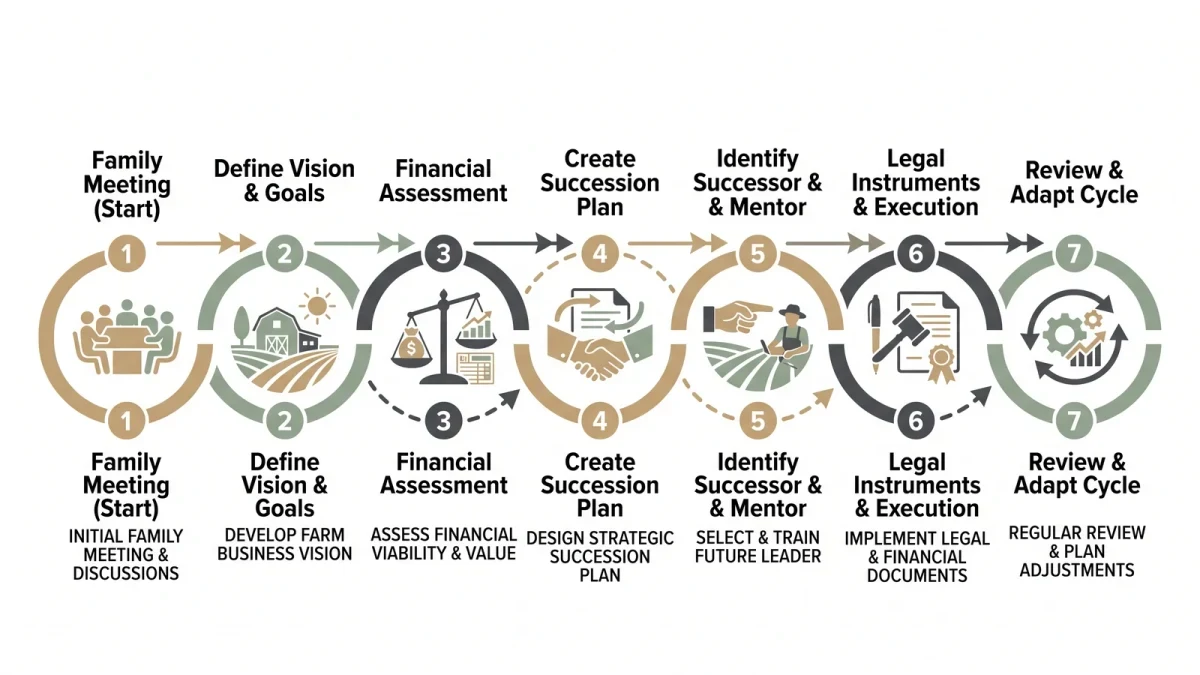
Farm succession planning follows a documented sequence: a family conversation about goals, a business and estate valuation, a successor development plan, and the legal and financial instruments to carry out the transfer, and it is urgent because the 2022 Census of Agriculture put the average producer age at 58.1 years with roughly 40 percent of U.S. farmland farmed by someone other than its owner, per USDA data. Extension surveys repeatedly find that most U.S. farm families have no written succession plan at all.
Farm Press Theme publishes information, not legal, tax, or financial advice. Succession is governed by state law and federal tax rules that change; every step below should be executed with the family's own attorney and accountant, and the tax figures cited here carry their source and date.
Why does succession planning stall so often?
Extension farm-management specialists document the same blockers: the senior generation avoids conversations about death and control; the operation's value is tied up in illiquid land, so treating heirs fairly costs cash the farm does not have; and the next generation, if it exists, may be uncertain about committing to a business with a decade of low-margin years. None of these resolve on their own. The documented consequence is that unplanned transfers end in forced sales and estate disputes, which is why agricultural law programs at land-grant universities across the country run succession workshops year after year.
What are the working steps?
The sequence below is a composite of documented university extension succession frameworks, ordered so each step feeds the next.
- Hold the family meeting first. Goals before tools: who wants to farm, who does not, what retirement income the senior generation needs, and what fairness means to this family. Extension guidance is to put the hard questions in writing before anyone drafts documents.
- Inventory the business. Assets and debts, land ownership and lease arrangements, equipment, enterprises, and the people and skills each one depends on, with current financial statements as the base.
- Value the operation. A defensible valuation, per a qualified appraiser for land and a farm accountant for the business, sets the ground for both estate planning and any buyout math among heirs.
- Choose and develop the successor. Documented successors need management experience beyond labor, so most frameworks phase in decision authority over several years, with defined milestones the successor can be held to.
- Match legal tools to the plan. Wills, trusts, business entities such as LLCs or partnerships, buy-sell agreements among heirs, and beneficiary designations must all point the same direction; contradictory documents are the most common failure extension attorneys report.
- Address the tax layer. The federal estate tax exemption was set at $15 million per person beginning in 2026 under the 2025 tax law, per IRS guidance, which removes federal estate tax exposure for the vast majority of farms, but state estate taxes, capital gains treatment, and basis rules at transfer still shape which assets move to whom and when.
- Write it down, fund it, and review it. A plan is complete when the documents exist, insurance or liquidity backs any buyout promises, and the family reviews it after every major event: a marriage, a land sale, a law change, a death.
How do families handle the fair-versus-equal problem?
The documented standoff: the farming heir needs the land to operate, while non-farming heirs expect an equal share of an asset that cannot be divided without crippling the business. Extension frameworks offer the standard options: unequal ownership balanced by other assets or life insurance to non-farming heirs; staged buyouts financed by the operation's cash flow; or entity structures that separate control, which goes to the operator, from economic value, which is shared. Every option prices someone's expectations against the business's liquidity, which is why step one's conversation happens before step five's documents.
What happens with no plan at all?
The default is state intestacy law: fixed shares to statutory heirs, no authority structure for the operating heir, and often a court-supervised partition that can end in a forced land sale. Meanwhile the 2022 census demographics, an average producer age of 58.1 and about a million producers with ten or fewer years of experience, mean a large share of U.S. farmland will change hands in the coming two decades whether families plan or not.
| Step | Output | Who is involved |
|---|---|---|
| Family meeting | Written shared goals | Family, facilitator |
| Business inventory | Assets, debts, enterprises | Operator, accountant |
| Valuation | Defensible value figures | Appraiser, accountant |
| Successor development | Phased management plan | Senior and next generation |
| Legal instruments | Aligned will, trust, entity | Attorney |
| Tax layer | Transfer structure | Accountant, attorney |
| Review cycle | Updated plan | Whole family |
Frequently asked questions
When should a farm family start succession planning?
Years before any transfer: extension frameworks recommend starting while the senior generation is fully in control, because the options shrink once health, capacity, or financial distress forces the issue. The documented best age to begin is whatever age the family is now.
What is the federal estate tax exemption for 2026?
It is $15 million per person beginning in 2026 under the 2025 tax law, per IRS guidance, indexed for inflation. That exempts most farm estates federally, though state estate and inheritance taxes and capital gains basis rules still matter.
How do you treat farming and non-farming heirs fairly?
Documented options include balancing the land with other assets or life insurance for non-farming heirs, staged buyouts financed by farm cash flow, and entity structures separating control from economic value. Every option trades expectations against business liquidity.
Can a succession plan be done without a lawyer?
The conversation, inventory, and goal-setting can and should be done by the family first. But the documents, wills, trusts, entities, buy-sell agreements, need an attorney admitted in the state, since state law controls, and contradictory self-drafted papers are a common failure.
What share of farms have a succession plan?
University extension surveys repeatedly find that most U.S. farm families lack a written succession plan, even as census demographics point to a large generational transfer of farmland over the coming two decades. The gap between need and preparation is the documented driver of forced sales.