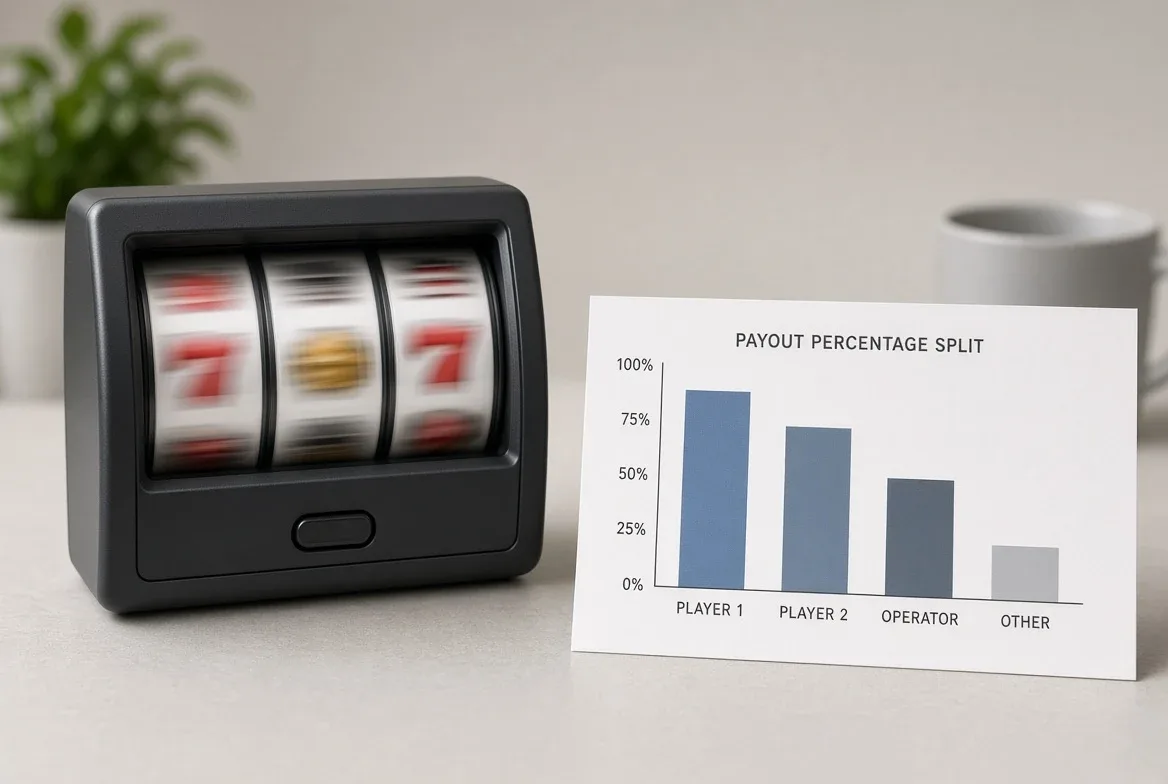
An 85% RTP means a slot is designed to pay back 85 pence of every pound wagered over a very large number of spins — not in any single session, according to the UK Gambling Commission's guidance for players. RTP is a long-run average that regulators measure over tens of thousands of plays, never a per-visit prediction.
What Does RTP Actually Mean?
RTP stands for return to player: the share of the money staked on a machine that is built to come back out as prizes over time. The Gambling Commission defines it as "part of the money paid to play the machine that is then given back to the player as prizes." The number on a paytable is the machine's design target, not a running scoreboard — it describes what happens across a very large sample of plays, not what any one player takes home.
Why Doesn't RTP Predict What Happens in One Session?
Because the average only shows up over volume. The Gambling Commission is explicit on this point: "The %RTP is an average achieved over a significant number of game plays and not each time the gaming machine is played." Its own example makes the gap concrete — an 85% RTP display does not mean a player should expect to get back 85 pence of every pound during any particular session. A short session can run well above or well below the published figure in either direction; that variance doesn't mean the number is wrong, it means the number describes the long run, not the next spin.
The flip side of RTP is the same figure read from the house's chair: if a machine returns 85% over time, it is built to keep the other 15% as the built-in cost of play. No pattern of betting, timing, or stopping changes that design target over time — the machine's math doesn't track how a player has been playing.
How Do Regulators Actually Check Whether an RTP Number Is Real?
Regulators don't take a single day's results as proof. Per the Gambling Commission's guidance for licensees, measuring RTP on too small a sample is "pointless as the tolerance will be too large for meaningful results" — a handful of spins can swing wildly either side of the design figure. Rather than fixing one universal play count, the Commission lets operators size the check to the game: common approaches include daily measurement against the previous 30 days of play, sometimes backed by a rolling 90-day figure, or waiting until a game has logged a set number of plays before checking it at all.
The guidance frames this as a tolerance band around a target: the theoretical RTP is treated as the centre line, with an allowable range above and below it sized to the game's volatility. As more spins accumulate, the observed RTP is expected to converge toward that theoretical line — the whole reason regulators wait for volume before trusting a number.
Is There a Minimum RTP a Slot Has to Offer?
Not in the UK. The Gambling Commission's guidance for players confirms no minimum RTP requirement applies to gaming machines — a licensed slot can be built anywhere on the payback scale, and the published figure is what tells a player where on that scale a given game sits.
Nevada's gaming regulator approaches the same math from the machine's side rather than the player's. Its slot audit rules describe how a "weighted average theoretical hold percentage" is calculated for multi-game machines — each paytable's theoretical hold weighted by how much coin-in it contributes — and require licensees to recalculate the combined "floor par" for a sample denomination annually. That published guidance sets out how hold percentages are calculated and verified rather than stating one minimum payback figure a player can look up, which is a different disclosure approach to the same underlying figure the UK reports as RTP.
Random Machines vs. Compensated Machines: Does RTP Work the Same Way?
Not quite, and the difference matters for what a published RTP is actually telling you. The Gambling Commission's guidance distinguishes two designs:
| Machine type | How the odds behave | What stays fixed |
|---|---|---|
| Random machines | Odds on each play are constant and unaffected by what happened on previous plays | The stated RTP applies evenly, play to play, over the long run |
| Compensated machines | Odds can vary based on previous game performance | Prizes are still determined by chance even as odds shift |
Either way, the published RTP is a design average measured across the machine's category-appropriate sample size — the Gambling Commission's guidance notes this is generally 10,000 or 100,000 games for compensated machines, and more for random machines depending on their category. The mechanism differs; the discipline of averaging over a large sample before trusting the number does not.
Frequently Asked Questions
- Does a higher RTP mean I'll win more in a single session? No. RTP is a long-run average, per the Gambling Commission — a single session's result can land well above or well below the published figure regardless of how high that figure is.
- How much play do regulators need before an RTP number can be trusted? The Gambling Commission sets no single fixed count; its guidance points operators toward measuring against a rolling window, such as the previous 30 or 90 days of play, or waiting for a set number of plays so the tolerance narrows enough to be meaningful.
- Is there a minimum RTP a slot has to offer? In the UK, no — the Gambling Commission confirms there's no minimum RTP requirement for gaming machines, so the published figure is what actually tells you where a game sits.
- What's the difference between RTP and hold percentage? They're the same measurement seen from opposite sides: RTP is the share returned to players; hold percentage, the figure Nevada's regulator calculates and audits, is the share the machine is designed to keep.
For a related guides perspective, read What RTP Means on a Slot Machine, and What It Doesn't Promise.
For more context, read What RTP Means on a Slot — and What It Doesn't Promise.
For more context, read administration.