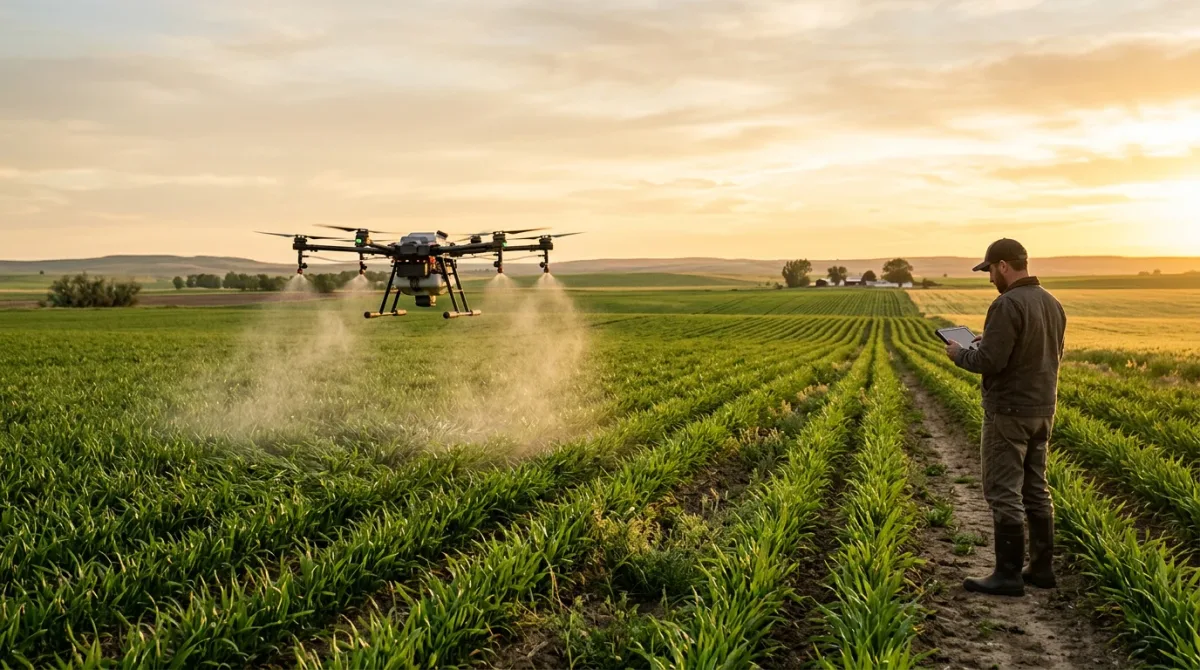
Spraying a field with a drone that weighs 55 pounds or more requires an Agricultural Aircraft Operator Certificate under 14 CFR Part 137, plus an FAA exemption filed at least 120 days before operations start, per the FAA's dispensing-chemicals guidance and Advisory Circular 137-1B. Lighter drones can operate under Part 107 with a narrower set of exemptions — but the paperwork clock still runs in months, not weeks.
That timeline, and the ownership math behind it, are the two things operators weighing a spray drone purchase or a custom-hire contract need to see clearly before the next spray window opens.
What certificate does spraying with a drone require?
The FAA treats agricultural aircraft dispensing operations the same way whether the aircraft carries a pilot or not: commercial spraying requires an Agricultural Aircraft Operator Certificate (AAOC), applied for on FAA Form 8710-3 and submitted to the agency's UAS certificates team, according to the FAA's guidance on dispensing chemicals with UAS. There is no separate "drone track" that skips the certificate — the difference is which other regulations the operator has to get an exemption from first.
For UAS operators specifically, the certificate itself is only the last step. Before an operator can even begin the formal AAOC application, the FAA requires a petition for exemption from the specific 14 CFR sections that don't already account for unmanned aircraft, submitted through regulations.gov.
How does the drone's weight change the process?
Weight sorts operators onto one of two regulatory paths, per the FAA's guidance. Drones under 55 pounds operate under 14 CFR Part 107 but still need exemptions from Section 107.36 — the rule barring hazardous-material carriage — and from the Part 137 provisions written for crewed aircraft; these operators register the aircraft with an FA number through FAADroneZone.
Drones at 55 pounds or heavier fall under 14 CFR Parts 91 and 137 and need exemptions from Parts 61, 91, and 137, plus registration with an N-number through the FAA's CARES system or by mail. Most of the larger spray platforms farmers and custom applicators are buying now — including the DJI Agras T40 that the University of Missouri used in its 2025 cost study, rated to carry roughly 10.6 gallons of spray liquid or 110 pounds of dry product — land in this heavier category once loaded, which is the path with the most exemptions to clear.
How long does certification actually take?
The FAA's Advisory Circular 137-1B, issued August 21, 2017 and still the governing document for both manned and unmanned Part 137 certification, lays out five phases: preapplication, formal application, document compliance, demonstration and inspection, and certification. Once the formal Form 8710-3 application is filed — with a letter of intent and schedule of events — "the certification team will review the application within 30 business days," per the advisory circular. That 30-day window covers only one phase; the FAA sets no single mandated total for the process.
For UAS operators, the exemption petition has to be filed and granted before the demonstration and inspection phase can start, and the FAA advises submitting that petition at least 120 days ahead of the planned start of operations. Applicants and their designated chief supervisor of operations are also tested on economic-poison handling, weight and balance, and emergency poison-control resources, including the National Pesticide Telecommunications Network, as part of the knowledge requirements the circular describes.
What does owning a spray drone actually cost per acre?
Once the certificate is in hand, the operating question becomes cost. The University of Missouri's Agricultural Business and Policy Extension published a 2025-season cost analysis, based on operations at the university's Lee Greenley Jr. Memorial Research Farm in Novelty, Missouri, using a DJI Agras T40. A farmer owning and running the drone at 1,000 acres a year spent $12.27 per acre — $8.90 in ownership costs and $3.37 in operating costs — while a custom operator spreading the same equipment across 4,000 acres brought that down to $7.39 per acre ($4.75 ownership, $2.64 operating), according to the extension publication.
Ownership cost is the larger piece of the bill for a farm-owned drone: the Missouri analysis breaks it into $6.58 per acre for depreciation and interest excluding batteries, $1.72 per acre for battery replacement, and $0.59 per acre for taxes, insurance, and housing. Those figures assume an 8% interest rate and a battery rated for roughly 1,000 charge cycles or five years — assumptions specific to this Missouri model and this machine, not a universal constant.
Is owning worth it, or is custom hire the better call?
The extension analysis puts custom hire rates around $16 per acre in the region it studied — well above either ownership scenario it modeled, which is the gap that makes drone ownership pencil out for operators with enough acres to spread the fixed cost. The breakeven point in the Missouri model is about 980 acres a year for a farmer running a single drone to bring per-acre cost near $12.50, and about 3,900 acres a year for a custom operator to reach roughly $7.50 per acre.
Below those thresholds, the fixed costs of depreciation, interest, and battery replacement outweigh what an operator saves by not paying a custom rate. These numbers come from one Missouri research farm, one growing season, and one drone model — a different region, chemical program, or machine will move the breakeven acreage, so operators comparing their own numbers should treat the Missouri figures as a benchmark to check assumptions against, not a rate to import directly.
Frequently Asked Questions
Does every ag spray drone need a Part 137 certificate?
Yes. Commercial dispensing operations need an Agricultural Aircraft Operator Certificate regardless of aircraft weight, per FAA guidance. Drones under 55 pounds still operate under Part 107, but they need exemptions from the hazardous-material rule and applicable Part 137 sections before they can spray.
How far ahead does an operator need to file the exemption petition?
At least 120 days before planned operations, submitted through regulations.gov, per the FAA's Part 137 UAS guidance. The exemption must be granted before an operator can move into the demonstration and inspection phase of the AAOC application.
How long does the FAA take to review the certificate application itself?
The certification team reviews the Form 8710-3 formal application within 30 business days, per FAA Advisory Circular 137-1B. That covers one of five phases; total time to certification depends on document compliance and inspection scheduling as well.
What's the breakeven acreage for owning a spray drone instead of hiring one?
About 980 acres a year for a single-drone farm owner, and about 3,900 acres a year for a custom operator running two drones, based on the University of Missouri's 2025 cost analysis using a DJI Agras T40. Different regions and machines will shift that number.
For more coverage, see Economic Benefits of a Sustainable Agricultural Revolution.