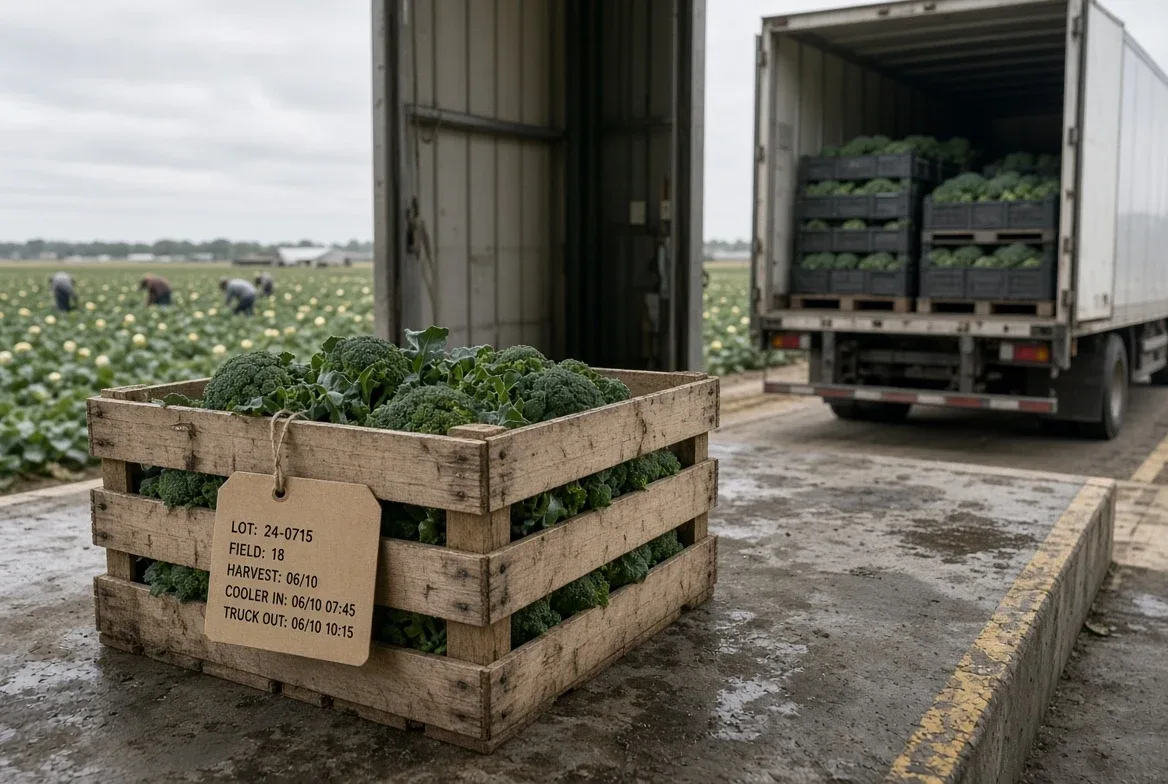
The FDA's Food Traceability Rule, originally due to take effect January 20, 2026, now has a compliance date of July 20, 2028 — a 30-month extension the agency finalized after industry told regulators their data systems weren't ready, per FDA's Federal Register notice. Farms that grow or handle food on the FDA's Food Traceability List still need to build recordkeeping for harvest, cooling, and initial packing lots before then, unless they qualify for an exemption.
The rule, formally "Requirements for Additional Traceability Records for Certain Foods" and known in the industry as FSMA 204, is a Food Safety Modernization Act regulation aimed at speeding up recalls and outbreak investigations. It requires firms handling specific high-risk foods to keep records tied to seven defined points in the supply chain, called Critical Tracking Events, and to be able to hand that data to the FDA within 24 hours during an investigation, according to FDA's rule summary.
What does the rule actually require?
The Food Traceability Rule applies only to foods on the FDA's Food Traceability List (FTL) — a defined set of commodities the agency judged higher-risk for foodborne illness, including many leafy greens, melons, tomatoes, certain fresh-cut produce, shell eggs, and some seafood and nut butters, per FDA's rule summary. It also reaches foods that contain a listed food as an ingredient, as long as that ingredient stays in the same form.
For each Critical Tracking Event a firm performs, the rule specifies Key Data Elements (KDEs) that must be recorded and linked to a traceability lot code. FDA's summary lists the CTEs as harvesting, cooling, initial packing, first land-based receiving of seafood, shipping, receiving, and transformation (processing, manufacturing, or repackaging). A farm typically touches the first three.
| Critical Tracking Event | Who performs it | Core data to capture |
|---|---|---|
| Harvesting | Farms removing raw commodities from the field or water | Commodity, quantity, harvest date, farm location, field or growing-area identifier |
| Cooling | Operations doing active temperature reduction after harvest | Commodity, lot code, location, date of cooling |
| Initial packing | First packaging of a raw commodity into a container | Commodity, quantity, packing date, location, lot code assigned |
Rutgers Cooperative Extension, in a farmer-facing summary of the rule, notes that covered farms must also document harvest date, purchaser identity, and reference documents, and keep a farm map showing where FTL foods are grown, so a lot code can be traced back to a specific field.
Why did the compliance date move to 2028?
FDA's Federal Register notice on the extension lays out the reasoning: many of the data elements the rule requires "are not routinely maintained or shared throughout supply chains, nor are many data systems currently interoperable throughout supply chains." The agency also cited distributors "struggling to obtain lot codes from their suppliers and experiencing challenges transmitting them to retailers in a cost-effective manner," and said very few regulated firms indicated they expected to meet the original January 2026 deadline.
FDA proposed extending the compliance date by 30 months, to July 20, 2028, and Congress separately directed the agency, in the Continuing Appropriations Act of 2026, not to enforce the rule before that same date, according to FDA's rule summary. The extension applies across the supply chain — growers, packers, processors, distributors, and retailers all move to the new date together rather than on a staggered schedule.
Which farms are exempt?
Not every operation growing an FTL commodity is covered. Rutgers Cooperative Extension's summary identifies four categories of exemption:
- Small-farm sales exemption. Farms averaging less than $25,000 in food sales over the prior three years, adjusted for inflation from a 2020 baseline, are fully exempt.
- Direct-to-consumer sales. Food sold or donated directly to consumers qualifies for exemption.
- On-farm packaging exception. Food packaged on the farm in a container that stays intact through to the consumer, and that carries the name, address, and phone number of the packer, is exempt.
- Direct-to-institution delivery. Food delivered directly to restaurants, schools, or other institutions, including under USDA food programs, is exempt.
None of these exemptions are automatic paperwork-free zones once food moves further down the chain, though: a buyer further along the supply chain who is covered by the rule may still ask an exempt farm for lot and harvest information as a condition of doing business, even though FDA itself does not require records from that farm.
What records will covered operations need to keep?
For farms that are covered, Rutgers Cooperative Extension's summary describes the rule as having "no phase in period as there has been for other parts of FSMA" — once the compliance date arrives, the full recordkeeping obligation applies at once, not in stages. Covered operations need a written traceability plan describing how they identify FTL foods they handle, how they assign and track lot codes, and how records are stored and retrieved. Records generally must be kept for two years from creation, per Rutgers Cooperative Extension's summary, and be producible within 24 hours if FDA requests them during an outbreak investigation, per FDA's rule summary.
What should operators do before 2028?
The extension buys time, not a pass. FDA's Federal Register notice frames the additional 30 months as time for growers, packers, distributors, and retailers to align on shared data formats and lot-code systems, since the agency's stated problem was less about any single farm's records and more about whether that data could move consistently between trading partners. Farms growing FTL commodities have time now to work out, with the buyers they sell to, what lot-code format and harvest documentation those buyers will expect once the rule is enforced — rather than building a system in the weeks before July 2028.
Frequently asked questions
For a related agribusiness perspective, read What 100% bonus depreciation means for your next equipment purchase.