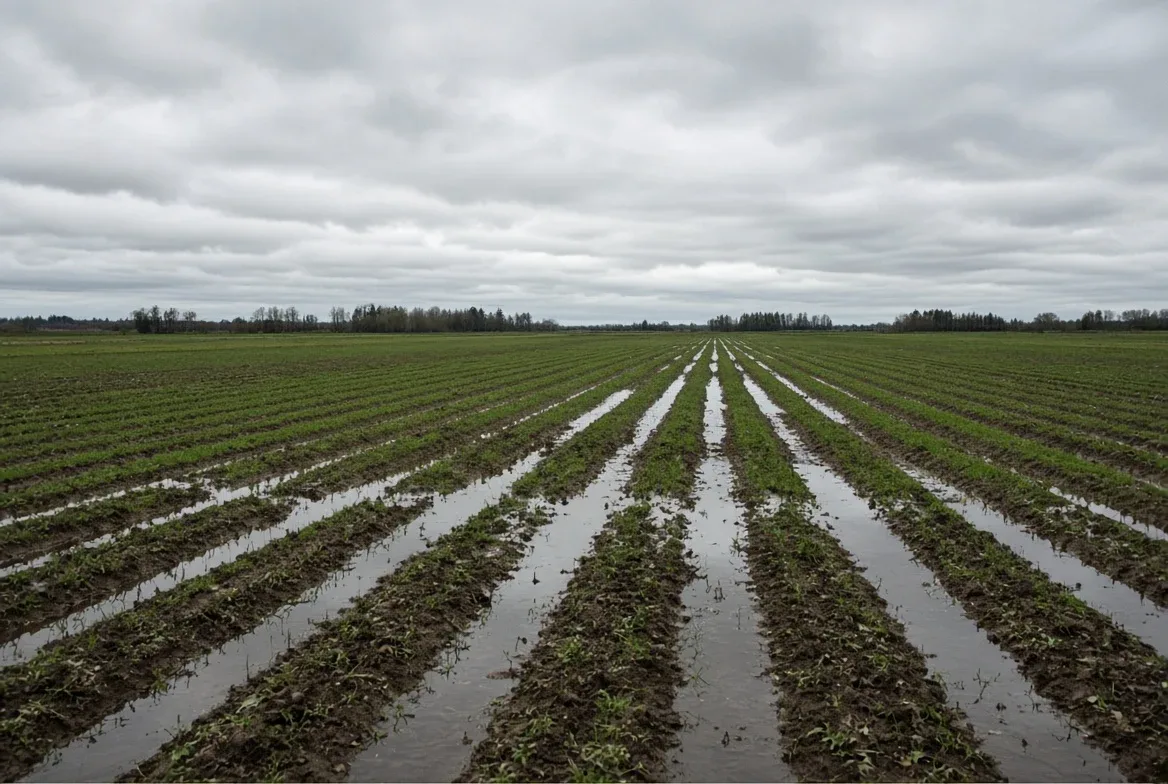
Prevented planting coverage pays 60% of a crop's original guarantee by default, with buy-up options to 65% or 70% selected at policy purchase, according to Iowa State University Extension's crop insurance guidance — actual final planting dates and late-planting windows vary by crop, county, and the policy's Special Provisions, per USDA's Risk Management Agency.
What counts as "prevented planting" under a federal crop policy?
Prevented planting is a specific, defined failure — not just a bad spring. USDA's Risk Management Agency (RMA) defines it as "a failure to plant an insured crop with the proper equipment by the final planting date designated in the insurance policy's Special Provisions or during the late planting period, if applicable." The cause has to be an insurable peril: excess moisture, flooding, drought, or another covered weather event that keeps equipment out of the field, not a marketing decision or a labor shortage.
The final planting date and the late planting period that follows it are not uniform across the country. RMA states plainly that these dates "vary by crop and by area," which is why the policy's Special Provisions — the document specific to a producer's county and crop — governs the actual calendar, not a national default. An operator working two states, or renting ground across a county line, can be working two different clocks in the same season.
How much does a prevented planting payment actually cover?
The base payment is 60% of the crop's original guarantee, per Iowa State University Extension's Ag Decision Maker guidance, unless the policy is written under a group protection plan. That 60% figure is the default a producer gets without paying extra; it is not the ceiling. Additional premium, elected when the policy is purchased — not after a wet spring is already underway — can raise the prevented planting guarantee to 65% or 70% of the original coverage level.
That distinction matters for the budget conversation before planting starts, not during it. A producer deciding on coverage levels in the winter is setting the prevented planting math for the following spring; there is no switching to the higher buy-up percentage once a field is already too wet to plant. The 60/65/70% figures are Iowa State Extension's summary of the standard provisions; a producer's own percentage is fixed in that year's policy documents.
What are the deadlines that actually trigger the payment?
In Iowa, Extension's guidance lists the final planting date for corn as May 31 and for soybeans as June 15, with late planting periods running to June 25 for corn and July 10 for soybeans — dates specific to Iowa's Special Provisions, not a national standard. RMA confirms the broader point: both the final planting date and the length of the late planting period differ by crop and by area, so a producer in a different state or a different crop zone should expect different dates on their own policy documents, not these Iowa figures.
During the late planting period, coverage typically steps down a set amount per day past the final planting date if the crop is still planted late rather than prevented — a mechanic separate from the prevented planting payment itself, and one that makes the actual Special Provisions document, not a general guide, the only reliable source for a given operation's numbers.
What happens if a different crop goes in after the deadline?
If a producer plants a second crop on prevented planting acres after the late planting period has ended, Iowa State University Extension's guidance describes the payment as reduced to 35% of the original prevented planting payment on the first crop, with the second crop then carrying its own full insurance coverage. That 35% figure comes from the same Iowa Extension summary of standard provisions cited above, and it is the mechanism behind a decision a lot of operators face in a wet year: leave acres prevented at the higher percentage, or plant something — often soybeans behind a prevented corn crop — and accept the reduced first-crop payment in exchange for a second insured crop in the ground.
How much acreage has to be affected before a claim qualifies?
Prevented planting isn't triggered by a few unplantable rows. Iowa State University Extension's guidance states the minimum qualifying area is 20 acres, or 20% of the intended acreage for insurance units under 100 acres — whichever standard applies to the unit in question. That threshold is part of why prevented planting claims tend to track genuinely widespread field conditions — regional flooding, a saturated spring — rather than isolated wet spots that a producer would ordinarily plant around.
Where prevented planting fits in the broader insurance program
Prevented planting is one provision inside a federal program that has grown substantially. As of 2024, roughly 89% of acreage across eight major field crops — barley, corn, cotton, oats, rice, sorghum, soybeans, and wheat — was enrolled in the Federal Crop Insurance Program, a 52-percentage-point increase from 1990 levels, according to USDA's Economic Research Service. Total insured acreage across all covered commodities reached 543 million acres for crop year 2024, and total program liability exceeded $192 billion that year, with row crops accounting for 65% of that liability.
That scale is the backdrop for why prevented planting rules get scrutinized closely in wet years: the base policies most row-crop operators already carry include this provision, and the percentage, the deadlines, and the acreage minimum are set well before the questionable planting window ever arrives.
Frequently asked questions
Does prevented planting coverage require a total loss of the crop? No. It applies specifically to a failure to plant by the final planting date or late planting period, per USDA's Risk Management Agency — a distinct trigger from yield loss on a crop that was actually planted.
Can a producer choose the 70% prevented planting level after a wet spring starts? No. Per Iowa State University Extension's guidance, the buy-up options above the 60% base are elected with additional premium when the policy is purchased, not adjusted once planting conditions are already in question.
Are prevented planting deadlines the same in every state? No. USDA's Risk Management Agency states that final planting dates and late planting periods vary by crop and by area; Iowa State University Extension's May 31 (corn) and June 15 (soybean) dates apply to Iowa's Special Provisions specifically.
What happens to the payment if a second crop is planted late on prevented acres? Per Iowa State University Extension's guidance, the payment on the original crop is reduced to 35% of the prevented planting payment, and the newly planted second crop then carries its own separate coverage.
How much of the country's row-crop acreage carries this kind of coverage? About 89% of acreage across eight major field crops was insured as of 2024, per USDA's Economic Research Service — up 52 percentage points from 1990.
For a related industry news perspective, read Economic Benefits of a Sustainable Agricultural Revolution.