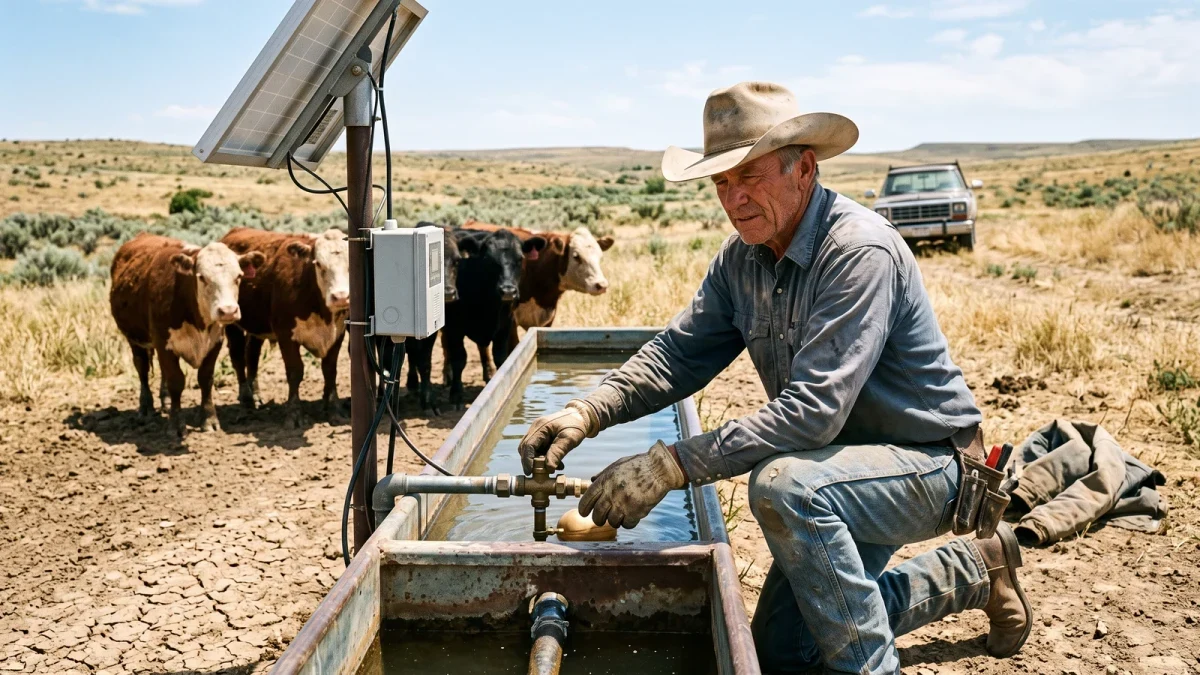
Drought hits ranch economics through feed and reproduction at the same time: forced liquidation at depressed prices, record-high hay and feeding costs, and the multi-year cost of rebuilding a cow herd that the U.S. had already drawn down to its smallest size in decades entering 2025, per USDA NASS Cattle reports, following the widespread Southern Plains droughts of 2020 through 2022 tracked by the U.S. Drought Monitor. Resilience, in the documented economics of range management, is a set of investments paid for before the dry year.
Ranch budgets are regional and operation-specific; the figures below carry their sources and dates, and drought-program rules are summarized from agency documentation only.
What does a drought year actually cost a cow-calf operation?
University extension ranch budgets across the Plains and Mountain West document the same pattern in dry years. Feed becomes the dominant cost: hay prices spike regionally when everyone is buying at once, and supplemental feeding stretches from winter into a full twelve months. Water costs follow, with stock tanks drying and hauling or piping water adding per-head expenses that normal years do not carry. Reproduction drops, open cows rise, and lighter weaning weights cut revenue per calf precisely when costs peak.
The liquidation trap is the documented worst case: selling breeding cows into a market flooded by other forced sellers locks in low prices and culls genetics, then repopulating later means buying back at high prices, a squeeze that followed the 2011-12 and 2020-22 Southern Plains droughts, per extension livestock economists.
What resilience investments show returns?
Range scientists and extension economists consistently identify a short list of practices with documented economics. Conservative stocking rates, carrying fewer cows than average rainfall could support, trade some revenue in wet years for the ability to keep the herd intact through dry ones; range research shows moderate stocking maintains vegetation and reduces the depth of forced sales. Rotational or rest-based grazing that leaves residual cover improves infiltration and recovery time after dry spells. Developed water, pipelines, tanks, and wells distributed across pastures, lets grazing pressure spread rather than concentrating on tank-lined ground. Reserve feed in the form of stored forage or standing stockpiled pasture cushions the first dry months, when decisions are still cheap.
The common thread: each investment buys decision time. The documented difference between ranches that weather a drought with the herd intact and those that liquidate is rarely the rainfall they received; it is how many weeks of flexibility their system had built in.
What do USDA disaster programs actually pay?
The Livestock Forage Program (LFP), administered by the Farm Service Agency under the permanent disaster framework that replaced ad-hoc payments, compensates producers in counties rated in drought intensity by the U.S. Drought Monitor, with payment levels rising with drought severity and duration. The Emergency Assistance for Livestock and Emergency Livestock Assistance programs cover additional losses including water hauling and feed transport under eligible conditions. The Emergency haying and grazing of Conservation Reserve Program acres is authorized in severe droughts, opening forage normally off-limits.
The documented limits matter for planning: LFP compensates for forage loss, not the full margin cost of a drought year, and payments arrive after the loss. Ranchers in drought-prone regions are advised by extension programs to treat the programs as partial backstops, not substitutes for the resilience investments above.
How do drought plans change the decisions?
Extension drought-management guidance converges on written trigger dates and actions decided in advance: specific dates by which, if rainfall or soil moisture is below threshold, the operation weans early, culls designated classes, secures feed, or rents pasture, before everyone else is bidding. The documented value of pre-set triggers is that they force action when it is cheap; early weaning, for instance, reduces cow nutrient requirements at the cheapest point in the feed year, per university beef extension research. Critical dates align with the region's rainfall pattern, in the southern Plains, spring and fall, elsewhere mid-summer.
| Resilience measure | What it buys | Documented basis |
|---|---|---|
| Conservative stocking | Herd retention through dry years | Range research; extension economics |
| Rest-based grazing | Faster pasture recovery | Range science, multiple regions |
| Distributed water | Even grazing use, rest options | Extension ranch planning |
| Feed reserve | Weeks of decision time | Extension drought budgets |
| Written trigger dates | Action before prices move | University drought-management programs |
Frequently asked questions
How small is the U.S. beef cow herd?
Entering 2025, the beef cow inventory was the smallest in decades, per USDA NASS Cattle reports, after drought-driven liquidation in the Southern Plains from 2020 through 2022. Herd rebuilding depends on heifer retention, which tightens feeder supply before it expands it.
What is the Livestock Forage Program?
LFP, administered by USDA's Farm Service Agency, compensates livestock producers for grazing losses in counties rated in drought by the U.S. Drought Monitor, with payments rising with severity and duration. It covers part of the forage loss, not the whole margin.
Why does conservative stocking pay off?
Carrying fewer cows than average rainfall allows leaves residual forage, which keeps pastures productive and lets the herd stay intact through dry years instead of being liquidated into a low market. Range research documents better long-run returns versus continuous heavy stocking.
What are drought trigger dates?
Pre-set calendar dates with rainfall or soil-moisture thresholds at which specific actions, early weaning, culling, or securing feed, are taken automatically. Their documented value is forcing decisions early, when feed is cheap and markets have not flooded.
Does drought assistance cover water hauling?
Partially, in eligible conditions: FSA emergency programs can share the cost of practices such as water transport under declared drought conditions, with documentation requirements. Extension guidance treats these as supplements, not primary drought plans.