The average U.S. cropland cash rent was $161 per acre in 2025, holding near its recent level, per the USDA NASS Cash Rents Survey released in 2025, and roughly 40 percent of U.S. farmland is farmed by someone other than its owner, per USDA Economic Research Service tenure data. Which lease structure carries that rent, fixed cash, crop-share, or a flexible hybrid, decides how commodity price and yield risk is split between the two parties.
Farm Press Theme publishes information, not legal advice. Lease terms are contracts governed by state law, and the comparison below is a starting frame; both parties should put any agreement in writing and review it with their own advisers.
What does each lease type do?
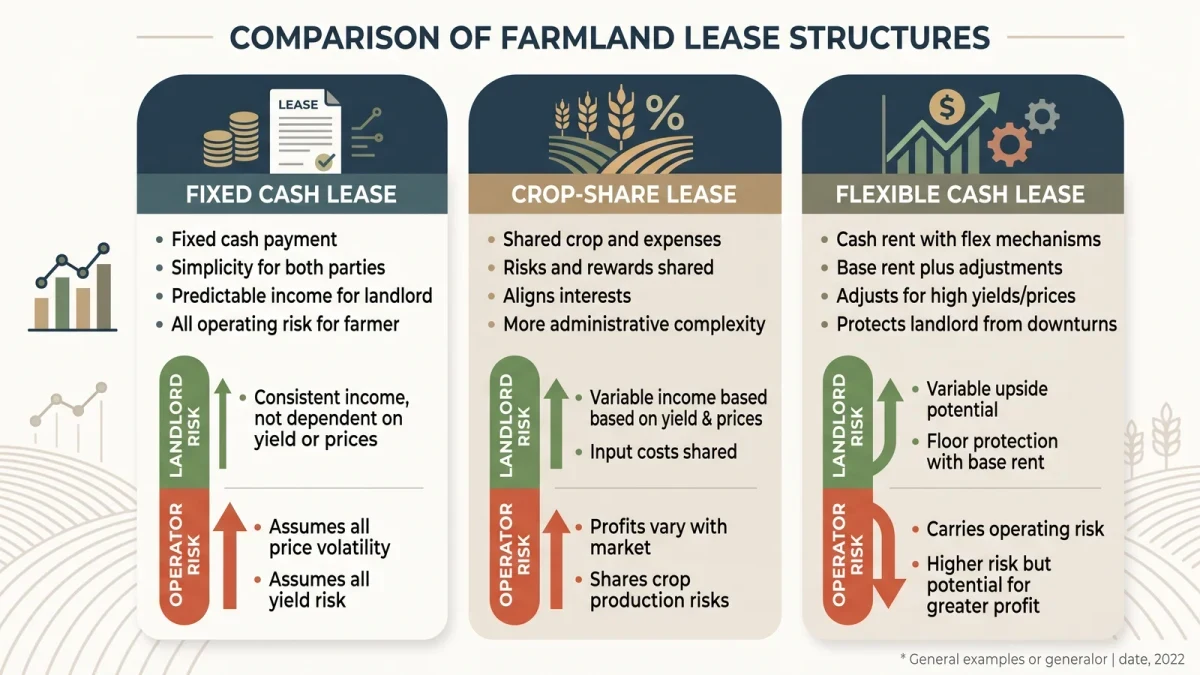
A fixed cash lease is simple: the operator pays a set dollar amount per acre, keeps the crop, and carries essentially all the production and price risk. The landowner gets a predictable income and no exposure to input bills or markets. A crop-share lease, the traditional Corn Belt and Plains structure, splits both the crop and specified input costs between operator and landowner on an agreed percentage, commonly 50-50 in classic wheat regions and various ratios elsewhere. A flexible cash lease, the structure extension economists have pushed hardest over the past two decades, starts from a base cash rent but adjusts the final payment up or down with a formula tied to yield, price, or gross revenue.
Rent type varies regionally for documented reasons: crop-share remains common where yield risk is high and landlords contribute inputs, while cash leasing dominates where yields are stable and landlords are absentee.
Who carries the risk under each structure?
Risk allocation is the real content of a lease. Under fixed cash, a poor crop year or low prices hit the operator alone; the landowner's risk is limited to the tenant's ability to pay and the farm's long-run productivity. Under crop-share, price and yield swings split automatically with the share, and the landlord shares input inflation too. Under a well-built flexible lease, years below the baseline cut the rent and years above it raise it, approximating the sharing without requiring the landlord to buy inputs.
The 2024 and 2025 row-crop price environment made this concrete: operators farming high cash-rent ground at 2022-level rents with 2025-level grain prices were squeezed, and extension ag economists across the Corn Belt reported renewed interest in flexible formulas for exactly this reason.
How is a fair cash rent set?
Documented anchors exist. The USDA NASS Cash Rents Survey publishes county-level averages for non-irrigated cropland, irrigated cropland, and pasture, with 2025 county estimates released September 2, 2025; university extension surveys, including Iowa State's cash rent survey series, add local detail. Extension budgets then frame what the tract can carry: expected gross revenue at documented prices and yields, minus non-land costs from the relevant university crop budget, leaves a residual that is the ceiling rent the operator can pay without subsidizing the land with off-farm income.
A rent set only by what neighbors paid last year ignores both sides' economics, and it is the documented cause of the over-rented acres that show up in tight years.
What should a written lease contain?
Extension agricultural law specialists recommend the same core terms regardless of type: parties and tract description; lease term and renewal or termination notice aligned with state law, which in several states requires notice well before the next crop year; rent amount, due dates, and any flexibility formula written as an equation, not a handshake; who pays for lime, drainage, tile, and other multi-year improvements, and how improvements are compensated at exit; conservation and tillage expectations; and, for crop-share, the exact input list each party funds. Oral year-to-year leases are still common and still the leading source of farmland disputes, particularly around termination timing.
| Feature | Fixed cash | Crop-share | Flexible cash |
|---|---|---|---|
| Operator risk | All price and yield risk | Shared with landlord | Shared via formula |
| Landlord income | Predictable, fixed | Varies with crop | Base plus adjustment |
| Input decisions | Operator | Shared with landlord | Operator |
| Best fit | Stable yields, absentee owner | High yield risk, engaged owner | Volatile prices, both engaged |
Which structure fits which situation?
For an absentee landowner who wants no market exposure, fixed cash with a competitively set, periodically re-bid rent is the documented default. For a landlord who lives near the farm, will share input costs, and wants income tied to the crop, crop-share keeps both parties' incentives aligned, which is why it persists in higher-risk regions. For an operator and owner who both want the rent to track reality, a flexible lease with a formula anchored to a price index such as a local elevator average and a yield measure, written by equation, is the structure extension economists document as most durable through volatile cycles.
Frequently asked questions
What was the average cash rent for cropland in 2025?
The national average cropland cash rent was $161 per acre in 2025, per the USDA NASS Cash Rents Survey, with county-level estimates released September 2, 2025. State and county averages vary widely, from tens of dollars in Plains grazing regions to several hundred on irrigated ground.
What share of U.S. farmland is rented?
Roughly 40 percent of U.S. farmland is farmed by someone other than the owner, per USDA Economic Research Service tenure data, and non-operator landlords hold the large majority of those rented acres.
What is a flexible cash lease?
It is a cash lease with a rent adjustment formula tied to yield, price, or gross revenue: a base rent moves up or down with the index. Extension economists recommend writing the formula as an equation so both parties can compute the outcome independently.
Why do crop-share leases persist?
Because they split risk. In regions where yields vary sharply, sharing the crop and the input costs keeps the landlord's returns tied to the farm's performance and the operator from bearing drought or price collapse alone.
Does a farmland lease need to be in writing?
Oral leases are legal in many states but are the leading source of farmland disputes, particularly over termination timing. Extension ag law guidance recommends a written lease covering term, notice, rent, inputs, improvements, and conservation expectations.