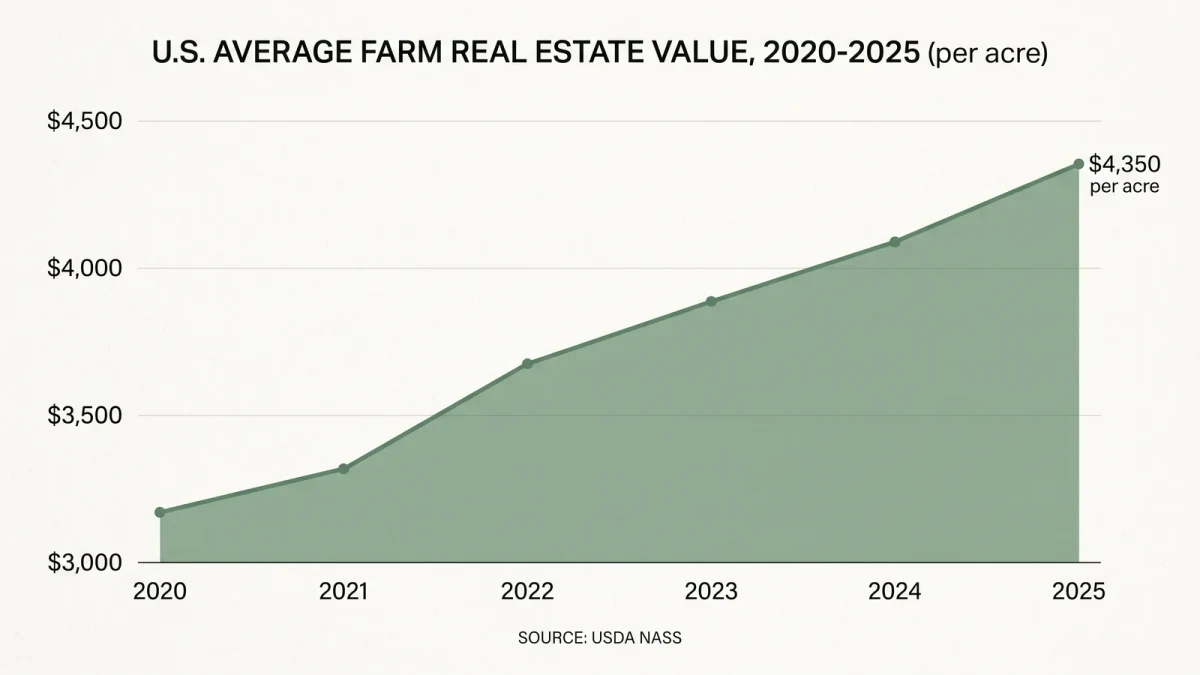
US farmland values keep setting records even after the rate-hiking cycle: average farm real estate value reached $4,350 per acre in 2025, up $180, or 4.3 percent, from 2024, per USDA's National Agricultural Statistics Service Land Values summary released August 1, 2025. Cropland averaged $5,830 per acre. The question for 2026 buyers is not whether land is valuable, but how financing costs reshape what a given rent stream can support.
Farm Press Theme publishes information, not financial advice. Nothing here tells anyone to buy, sell, or hold land; the numbers are documented benchmarks, and the financing math is each operation's own.
Why did land values keep rising while rates were high?
Three forces held values up through the Federal Reserve's tightening and the partial easing that began with rate cuts in late 2024. First, the 2020–2022 commodity run left many operations with cash to deploy, and land is where row-crop profits traditionally go. Second, supply stays thin: quality farms trade rarely, often between neighbors, and estate transfers remove more acres from the open market than auctions add. Third, institutional and recreational demand stayed selective but present in regions like the Corn Belt and Delta.
USDA's 2025 increase of 4.3 percent, per the August 1, 2025 NASS release, was slower than the roughly 5 percent gain the prior year, a sign that higher borrowing costs were already damping the top of the market, not collapsing it.
How do interest rates actually enter farmland math?
Land purchase decisions run on the spread between the cap rate and the cost of money. The cap rate is cash rent divided by price: a $300 rent on $8,000 Iowa-type corn ground is under 4 percent. When operating loans and farm mortgages cost more than that spread leaves, leveraged buyers step back, cash buyers keep setting the floor, and volume falls before price does.
The rate channel also works through rents. Operators facing 8-percent-plus operating credit in recent years bid less aggressively for cash rents, and stressed cash flows show up first in rent negotiations, then in land auctions a season later.
What changed after the Fed's late-2024 cuts?
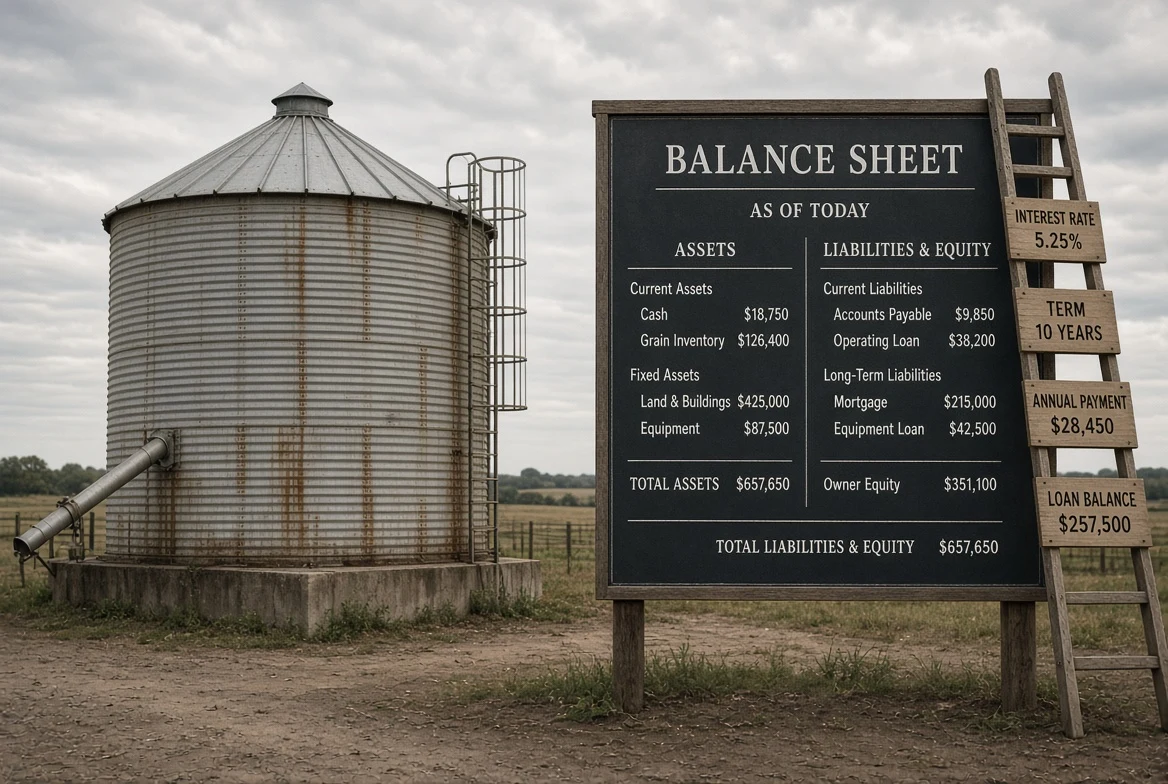
The Federal Reserve cut its policy rate in September, November, and December 2024, the first easing since 2020. Farm credit does not reprice overnight: fixed-rate land loans made in 2021–2022 at the lows still anchor many balance sheets, while new money borrowed since 2023 has carried materially higher rates. As of early 2026, the practical effect is a two-tier market: owners of cheap fixed-rate debt can hold and buy, while operators dependent on variable-rate operating credit feel every quarter-point.
Which regions look most rate-sensitive?
Regions where cash rents are low relative to price, and where dairy and livestock margins are compressed, are most exposed, because the cap-rate cushion is thinnest there. USDA's 2025 state-level data showed the Upper Midwest and Corn Belt holding firm while some Plains states, Nebraska among them, logged modest declines, per the NASS Land Values 2025 summary.
What should an operator do with this before a land decision?
Run the purchase against a stress case, not the broker's pro forma: rent flat or down 10 percent, operating rate a point higher, and one flood, drought, or tariff year in the first five. Know your lender's position on term, prepayment, and renewal structure before signing, because the same headline rate can behave very differently across a 20-year amortization.
Second, separate the investment case from the operating case. Some operations are better served cash-renting more acres and keeping capital liquid in a high-rate environment; others with cheap fixed financing and a succession plan will still buy. Both can be right on the same quarter-section.
How do cash rents respond to the same pressures?
Rents are the transmission belt between credit costs and land prices, and they lag both. A landowner with a paid-off farm reads falling interest rates as good news and holds rent steady; an operator whose operating line repriced upward walks into spring negotiations with a different ceiling. The result in most regions has been rents moving sideways rather than down, because owners carry no debt forcing their hand and retiring operators keep farming their owned ground through tenants rather than selling.
For tenants, the practical move is negotiating multi-year leases with yield-adjusted flex clauses instead of chasing the single-year low. A three-year lease at a fair base rent, with a bonus triggered by county-average yields above a stated threshold, holds more value than a one-year discount won in a year lenders are tightening, because the discount reverts at renewal while the relationship does not. Put drainage, fertility, and stewardship expectations in the same written lease; undocumented goodwill evaporates exactly when money gets tight, and handshake terms are the first casualty of a thin-margin year on either side.
What data will settle the 2026 direction?
Watch three series: USDA's NASS Land Values release each August, the Kansas City Fed's quarterly farmland and credit surveys for the Tenth District, and the Federal Reserve's policy path. If rates keep easing while commodity incomes recover, the 2026 reading likely shows another record. If incomes stay squeezed, expect thinner sales volume before lower prices.