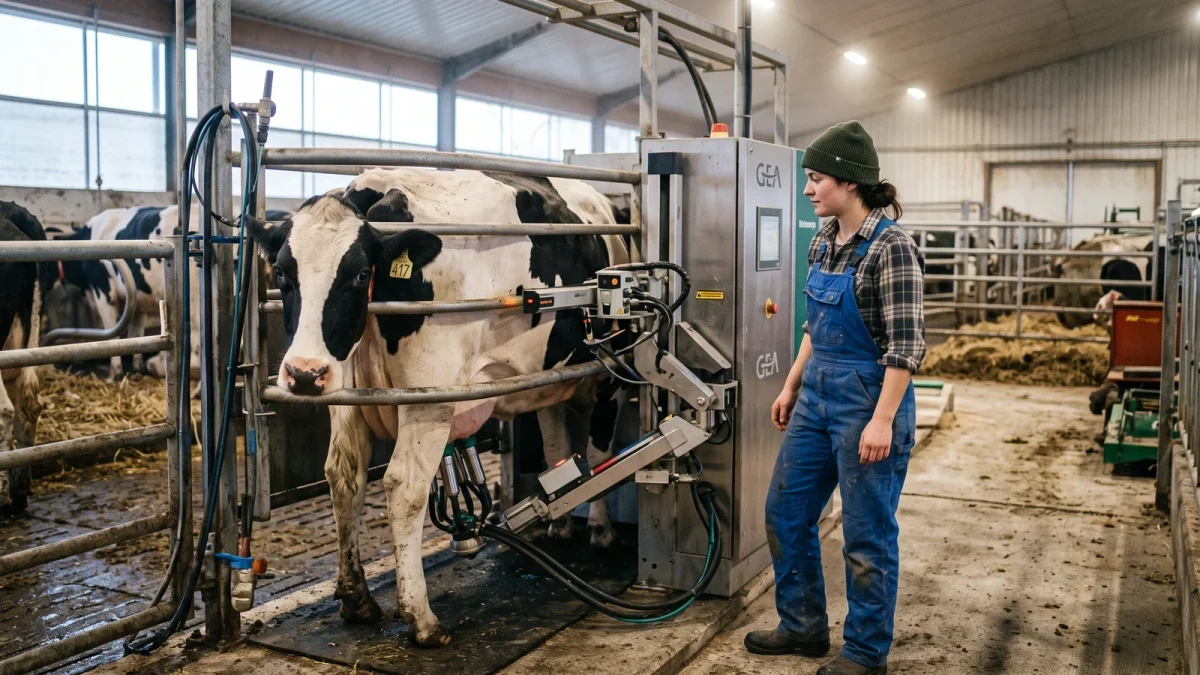
Robotic milking, or the use of two or more precision dairy technologies, increased US farmers' dairy net returns by 13 percent on average, per USDA Economic Research Service report ERR-356, released January 22, 2026, by economists Jonathan McFadden and Zach Raff. The finding gives livestock operators the clearest federal-research benchmark yet for a category long on vendor claims and short on independent numbers.
Farm Press Theme publishes information, not financial advice. This report is drawn from ERS publications and its own data summaries; no equipment maker's marketing is treated as evidence.
What did the ERS report actually measure?
The analysis uses USDA's Agricultural Resource Management Survey data, which follows a nationally representative sample of dairy operations, and finds adoption of precision technologies covering milking, breeding, and herd data systems has increased steadily since 2000. The 13 percent net-returns gain attached to robotic milking or to bundles of two or more technologies, meaning partial adoption does not deliver the same effect as a system.
How fast is adoption actually moving?
Slowly but measurably, and unevenly by herd size. An ERS chart of note published June 2, 2026 reported robotic milking produced 6 percent of US milk in 2021, up from 4 percent in 2016, and that adoption was highest among midsized operations: 13 percent of dairies with 150 to 499 cows used it by 2021. That midsized concentration matches the economics: enough cows to spread the capital cost, few enough that saved labor changes a real payroll line.
Where do the returns come from?
Per the ERS analysis, adopters spent less on paid and unpaid labor and on veterinary costs and medicine, consistent with earlier university trials of sensor-based health monitoring that caught mastitis and lameness earlier. In other words, the gain is cost-side discipline, not a milk-price premium, which makes it durable: efficiency gains survive commodity cycles that premiums do not.
What does this mean beyond dairy?
Dairy is the measured sector because ARMS captures it, but the same logic is pushing sensors into beef, swine, and poultry barns: feed-intake monitoring, environmental controls, and animal-level identification. Operators evaluating any of it now have a federal-research anchor point: bundled technologies with real data flows moved a documented performance measure, single gadgets did not.
What should an operator weigh before committing?
Three questions govern the decision at the farm gate. Does the herd size spread the fixed cost, per the midsized-adoption pattern ERS documents? Is there a plan for the data, since the labor saved partially converts to management time watching dashboards? And what is the service arrangement, given that a down robot stops milking? The 13 percent figure is an average across adopters, not a guarantee; the operations behind it paired equipment with management change.