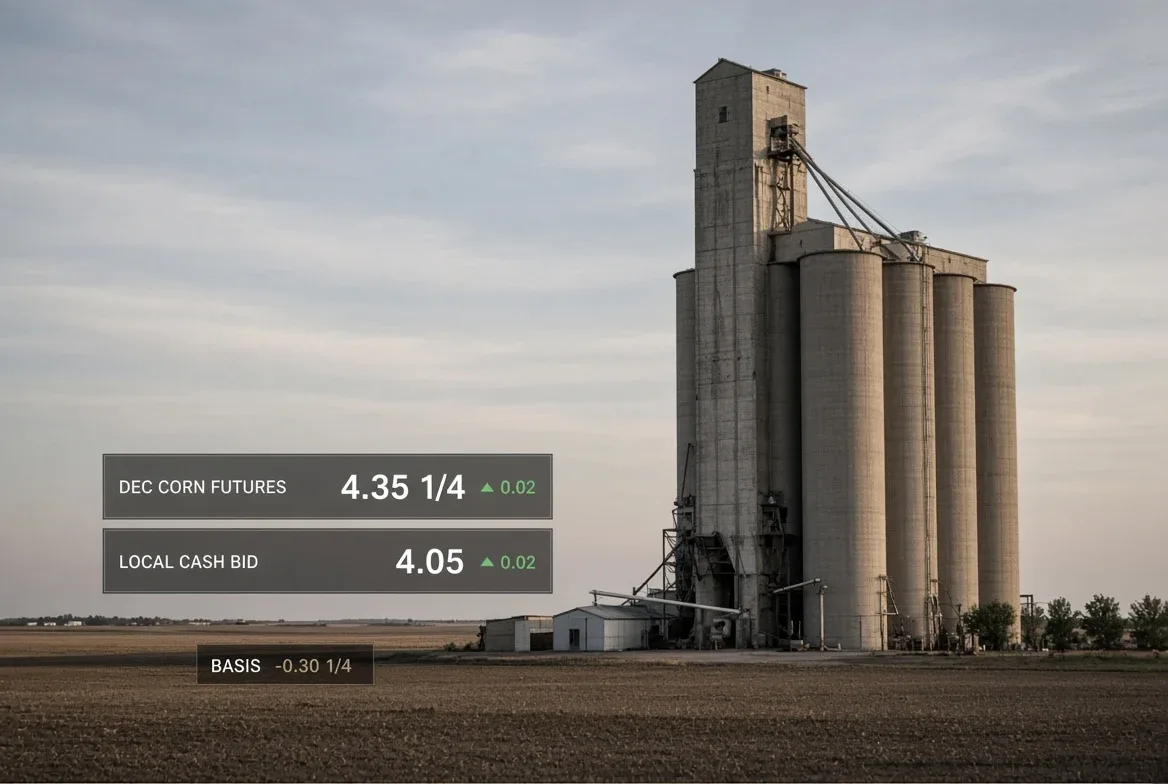
Basis is the difference between a local cash grain price and the nearest futures contract price, per USDA's Agricultural Marketing Service. It is the number that turns a board price into what an elevator actually pays at the scale, and it moves independently of the futures market itself. In west central Indiana, corn basis fell to a 15-year low in September 2024 and soybean basis hit a five-year low in the same window, according to Purdue University's Center for Commercial Agriculture.
That is the qualification worth carrying into any marketing conversation: basis is local. Two elevators forty miles apart can post different numbers on the same morning, and the gap between them is not noise — it reflects real differences in freight, storage capacity, and who needs grain right now.
What does the basis number actually mean?
The calculation is a subtraction: cash price minus the price of the nearby futures contract. Nebraska Extension's CropWatch program lays out the same relationship the other direction — cash price equals the futures price plus basis — so a negative basis (grain trading "under" the board) and a positive basis (trading "over") both fall out of the same formula. Nebraska cash corn and soybean bids have typically run under the futures price, a pattern the extension program attributes to the state's distance from major demand centers.
Basis is not set by a national market maker. Individual buyers — elevators, processors, exporters — set and adjust their own basis based on local supply and demand, grain quality, and their own cost of doing business, per CropWatch. Grading, storing, and shipping grain to a processor all cost money, and those costs are passed to the farmer through basis rather than through a separate line-item fee. An elevator with a longer rail or truck haul to its end market, or one running short on bin space during harvest, has more of those costs to recover, and that shows up as a wider (weaker) basis at that specific location even when the futures board has not moved at all.
That is also why basis is not interchangeable across delivery points the way a futures price is. Two producers selling the same bushel of corn on the same day, to two different buyers a short drive apart, can see two different basis numbers because each buyer is pricing in its own freight, storage, and demand situation rather than a shared national cost structure.
Why does basis move week to week?
Because it is a local supply-and-demand signal layered on top of a national futures price. When a nearby processor or export terminal needs bushels faster than farmers or elevators are willing to sell, buyers bid basis up to pull grain in. When local storage is full and elevators would rather not take on more inventory, basis weakens even if the futures market is unchanged. Basis also carries a seasonal shape: Purdue's basis review describes a historical pattern of basis strengthening from October through June and peaking in June, as stored old-crop supplies tighten ahead of the next harvest.
What did basis actually do in 2024-2025?
West central Indiana's 2024-2025 marketing year broke from that seasonal script. After the September 2024 lows, both corn and soybean basis strengthened through October, November, and December by more than the historical pattern would have predicted, according to Purdue's review. By February and March 2025, basis levels had converged with or moved above their historical averages for that time of year — a faster recovery than the typical seasonal curve alone would explain.
Early indicators for the 2025-2026 marketing year, per the same Purdue review, show corn basis opening stronger than where it stood at the same point in 2024-2025, while soybean basis has run close to the prior year's level. Both remain below their longer-run historical averages for west central Indiana, and Purdue's analysts expect basis to weaken or stabilize as harvest volume increases — consistent with the seasonal pattern the 2024-2025 year departed from.
How should an operator use basis information?
Basis is a local, elevator-specific number, and reading it well means comparing it against a local baseline rather than a national average. CropWatch recommends that producers keep their own historical basis records by elevator, built from past local bids, so a current quote can be measured against what that same buyer has historically paid at that same point in the marketing year. A basis that looks weak against the futures board might be normal for a given elevator in September and still be worth flagging if it is unusually weak relative to that elevator's own history.
None of this substitutes for tracking the numbers at your own delivery points. Basis behavior in west central Indiana, documented above, will not match basis behavior in Nebraska or any other region — freight lanes, storage capacity, and local demand are different in each. Farm Press Theme does not forecast where basis or futures prices are headed; the historical patterns above are reported as documented, not as a signal to buy, sell, or hold.
The practical takeaway is a habit, not a forecast: pull basis quotes from the same one or two buyers over time, note the date and the futures contract each quote is measured against, and compare a new quote to that same buyer's own history for that point in the marketing year rather than to a headline national average. A basis quote that looks identical in dollar terms at two different elevators can represent very different local conditions once freight and storage costs are backed out, which is why the documented, elevator-specific record — not a single published basis figure — is what CropWatch and Purdue's review both point back to.
Frequently asked questions
For a related industry news perspective, read Economic Benefits of a Sustainable Agricultural Revolution.
For more context, read What basis means for the price your elevator actually pays.
For more context, read USDA's August 2025 WASDE sized a big corn crop.