Roughly 116,600 U.S. farms sold $3.3 billion of food directly to consumers in 2022, up 16 percent from 2017, per the 2022 Census of Agriculture — evidence that adding enterprises is a real and growing strategy, not a hobby fringe. But the same census records show the largest share of U.S. production concentrated in large-scale specialized operations. Which strategy wins depends on scale, management bandwidth, and risk tolerance, not on a universal rule.
Farm Press Theme publishes information, not financial advice; the comparison below works from documented survey data and farm-structure research.
What does diversification actually buy a farm?
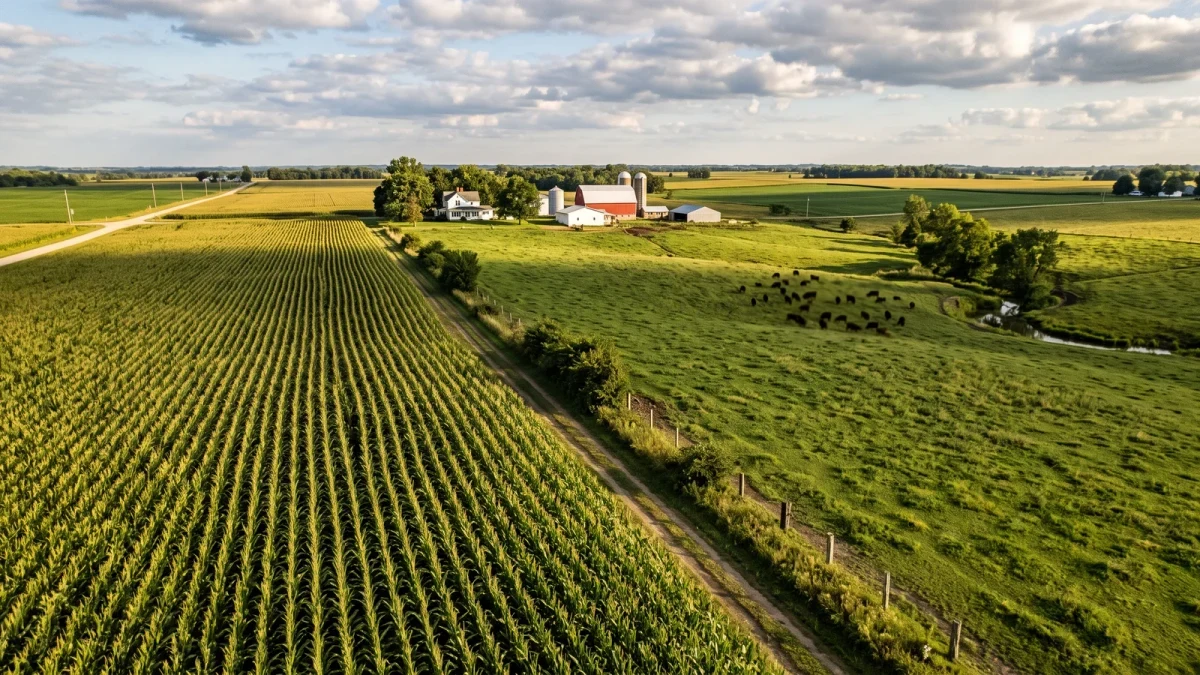
Two things, both documented in farm economics literature. First, income smoothing: enterprises with imperfectly correlated revenue — crops and livestock, grain and agritourism — tend to have bad years that do not overlap, which steadies cash flow and, in the research on farm survival, is associated with lower exit risk for small and mid-size operations. Second, resource utilization: a diversified mix can spread labor and machinery across more of the calendar, raising asset use per dollar invested.
The 2022 Census figures on direct sales illustrate the diversification channel: farms adding a consumer-facing enterprise captured $3.3 billion in 2022, and the number of farms doing it grew. Diversification is not new; it is a reordering of old logic — the mixed farm — enabled by new retail channels.
What does specialization buy?
Scale economics. Specialized operations concentrate management attention, buy inputs in larger volume, standardize machinery, and repeat one production system until its costs are as low as the region allows. USDA Economic Research Service farm-structure work has long documented that most U.S. production comes from large family farms running tight rotations, and university enterprise budgets show per-unit costs falling with volume within any single enterprise.
Specialization also fits labor reality: one deep system can be run well by a small, stable crew, while a diversified operation needs either broader skills in-house or more hired management.
How does risk compare between the two strategies?
Diversification spreads agronomic and market risk across enterprises; specialization concentrates it but deepens the tools for managing it — crop insurance at high coverage levels, forward pricing at scale, and production expertise that narrows yield variance. The choice is between spreading exposure and mastering it.
| Dimension | Diversified operation | Specialized operation |
|---|---|---|
| Income stability | Multiple revenue windows, less correlated | Concentrated in one system and window |
| Cost position | Smaller volumes per input, less buying power | Volume pricing, standardized machinery |
| Management load | Multiple systems, more skills required | One system run deeper |
| Labor use | Spread across seasons | Peaks in key windows |
| Capital use | More, smaller asset sets | Fewer, larger, better utilized |
| Main failure mode | Under-managed side enterprises | Single-system shock |
When does each strategy win?
Diversification tends to win where land base is limited, marketing proximity matters, and household labor can absorb new enterprises: small and mid-size farms near population centers adding direct-market, value-added, or livestock enterprises to a grain core. The 2022 Census direct-sales growth is concentrated in exactly that segment.
Specialization tends to win where scale is available: large contiguous acreage, high-capacity machinery, and operators whose skill advantage is in one system. For these operations, adding a half-managed side enterprise can subtract more profit than it adds — a documented pattern in case work on enterprise budgets, where marginal enterprises show negative return over all costs once land and labor are charged honestly.
How should an operator choose between them?
Test the proposal against the enterprise budget before the commitment. Any new enterprise should be projected with its own budget — revenue, variable costs, land, and labor charged at their real costs — and compared against the marginal return of deepening the existing enterprise. Three questions do most of the work:
- Does the new enterprise use resources in windows the core enterprise leaves idle?
- Who manages it daily, and what does that displace?
- What is the exit cost if it underperforms for three consecutive years?
The census data shows both strategies coexisting at scale in U.S. agriculture, which is the honest answer: the strategy that wins is the one matched to the operation's size, location, and management capacity.
Frequently asked questions
Is a diversified farm more profitable than a specialized one?
Not uniformly. Diversification tends to stabilize income and reduce exit risk for small and mid-size farms, while specialization tends to lower per-unit costs where scale is available. Profitability depends on how well each strategy is matched to the operation's scale, markets, and management capacity.
How many farms sell directly to consumers?
About 116,600 farms generated $3.3 billion in direct-to-consumer food sales in 2022, up 16 percent from 2017, per the 2022 Census of Agriculture released by USDA NASS in February 2024.
What is the main risk of specialization?
Concentration. A single production system exposed to one weather pattern, one pest complex, and one market leaves the operation fully exposed to a single shock. Specialized operators manage that with high-coverage crop insurance, forward pricing, and deep production expertise.
Can a farm be too diversified?
Yes. Side enterprises that are under-managed, under-capitalized, or charged honestly for land and labor frequently show negative returns in enterprise budget analysis. The test is whether each enterprise still pays after its full costs, not whether it brings in any revenue at all.