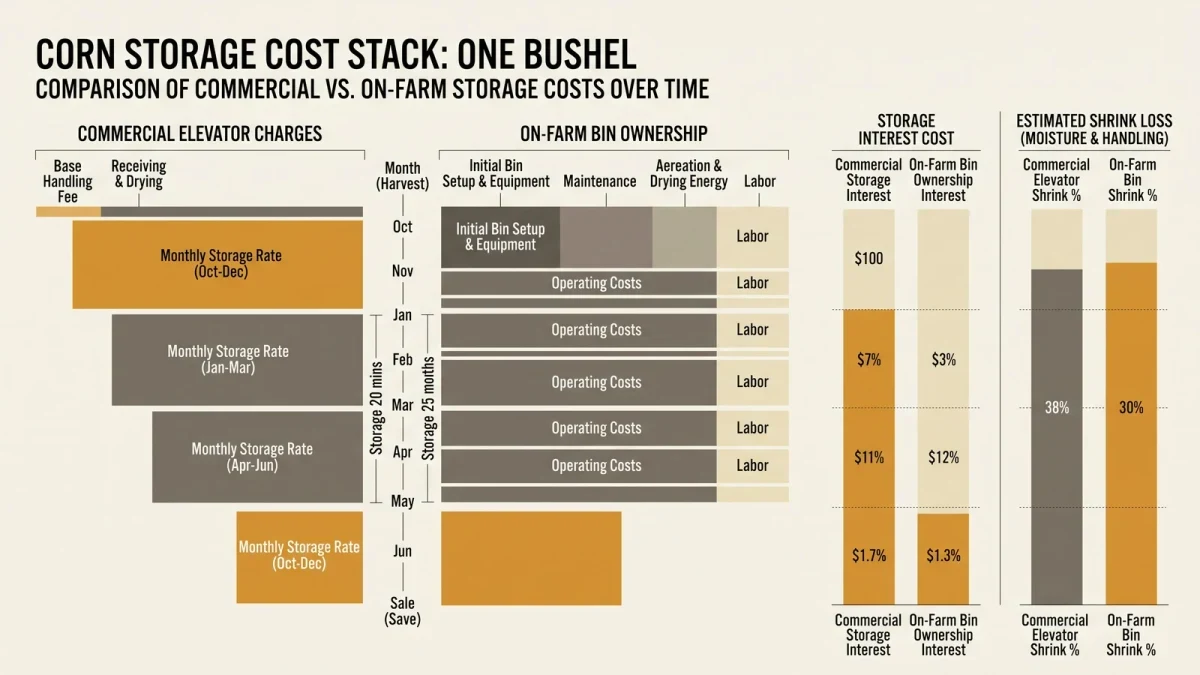
Commercial grain storage in Iowa typically runs 9 to 16 cents per bushel for the first three months, then 2 to 4 cents per bushel for each additional month, per Iowa State University Extension's storage rental rate guide (Ag Decision Maker C2-24, 2025 revision). Storage pays only when the expected improvement in price plus basis outweighs that meter, plus interest, shrink, and quality risk. The storage decision is a calculation of carry against a documented cost, not a bet on rally.
What does storing grain actually cost per bushel?
Start with the elevator rate card: Iowa State's 2025 guide reports the 9-to-16-cent initial charge covering the first three months and 2 to 4 cents monthly thereafter, with commercial rates varying by region and elevator. On-farm storage replaces the elevator charge with ownership costs — bin depreciation, repairs, electricity for aeration, and labor — which university summaries commonly put in the range of 30 to 50 cents per bushel annually once handling and shrink are included.
Two costs get forgotten most often. Interest on the stored crop's value: every month of storage ties up money that could have paid down operating debt, and at recent operating loan rates that is real money per bushel per month. And shrink: corn dried and stored loses moisture weight, so fewer bushels come out than went in.
How do basis and carry fit into the equation?
Basis is the local cash price minus the futures price, and carry is the spread between nearby and deferred futures. A store-and-later-sell plan wins when basis strengthens more than the storage meter runs. The arithmetic framework extension economists use is simple: expected price improvement (cash gain plus basis gain) minus total storage cost, interest, and shrink, compared against the cash price at harvest.
The discipline is using documented numbers at each step — today's basis, the elevator's rate card, your lender's interest rate — and recognizing that the expected price improvement is the only assumption in the stack. Everything else is arithmetic. That is why this site reports carry mechanics and cost benchmarks and leaves the price outlook to named forecasters with dates.
On-farm bin or commercial elevator: which is cheaper?
Depends on hold length and volume. Commercial storage is priced in known monthly increments and carries no capital outlay, which suits short holds and irregular volumes. On-farm bins front-load capital but lower the per-bushel cost of long holds, and they add marketing flexibility — the ability to load out at any point of the year without queueing behind harvest lines.
| Factor | Commercial elevator | On-farm bin |
|---|---|---|
| Initial charge | 9–16¢/bu first 3 months (Iowa, ISU 2025) | None; depreciation instead |
| Ongoing cost | 2–4¢/bu per month after | Aeration power, repairs, labor |
| Capital required | None | Bin and site investment |
| Best fit | Short holds, overflow volume | Long holds, repeat annual volume |
| Added risk | Rate changes, queue at load-out | Spoilage, monitoring burden |
What does quality risk do to the calculation?
Stored grain is a perishable inventory. Corn held above recommended moisture develops spoilage organisms; a warm February spell inside a poorly probed bin can turn a planned March sale into a discounted distressed load. The management cost of storage — checking, coring, running fans — belongs in the calculation even though it never appears on an elevator invoice.
The rule of thumb from extension storage specialists: cool the grain into winter temperatures, keep it dry, and check it monthly at minimum. Budget the labor for that, because a storage plan that assumes zero attention is a plan with an unbudgeted loss tail.
How should an operator run the store-or-sell number?
A workable sequence, using your own documented inputs:
- Write down the harvest cash price offered today, and the basis it implies.
- Pick the target sale month and write the deferred price and historical basis for that month from your own records.
- Add up storage cost to that month — elevator rate card or bin ownership cost, interest on tied-up capital, expected shrink.
- Subtract the cost stack from the expected price improvement. A negative number answers the question; so does a positive one thinner than a normal basis swing.
- Re-run the arithmetic whenever basis moves sharply, because the answer changes with it.
None of this predicts where prices go. It sizes the hurdle that the market has to clear for storage to have paid, and it puts the region, date, and source on every cost in the stack — which is the only honest way to publish the math.
Frequently asked questions
How much does commercial grain storage cost per month?
In Iowa, the documented benchmark is 9 to 16 cents per bushel for the first three months and 2 to 4 cents per bushel for each additional month, per Iowa State Extension's 2025 storage rental guide. Rates vary by elevator and region, so use your local rate card.
What is basis and why does it matter for storage?
Basis is the local cash price minus the futures price. Storage tends to pay when basis strengthens over the holding period by more than storage costs, interest, and shrink. Track your local basis history by month to make that comparison with evidence.
Does on-farm storage always beat the elevator?
No. Bins carry capital cost and management burden, and they win mainly on long holds and repeat volumes. For short holds or overflow bushels, the elevator's known monthly rate is often cheaper than annualized bin ownership costs.
What hidden costs do operators skip in storage math?
Interest on the value of the stored crop, shrink from moisture loss, drying costs already sunk at harvest, and the labor of monitoring. A complete calculation includes all four alongside the visible storage rate.