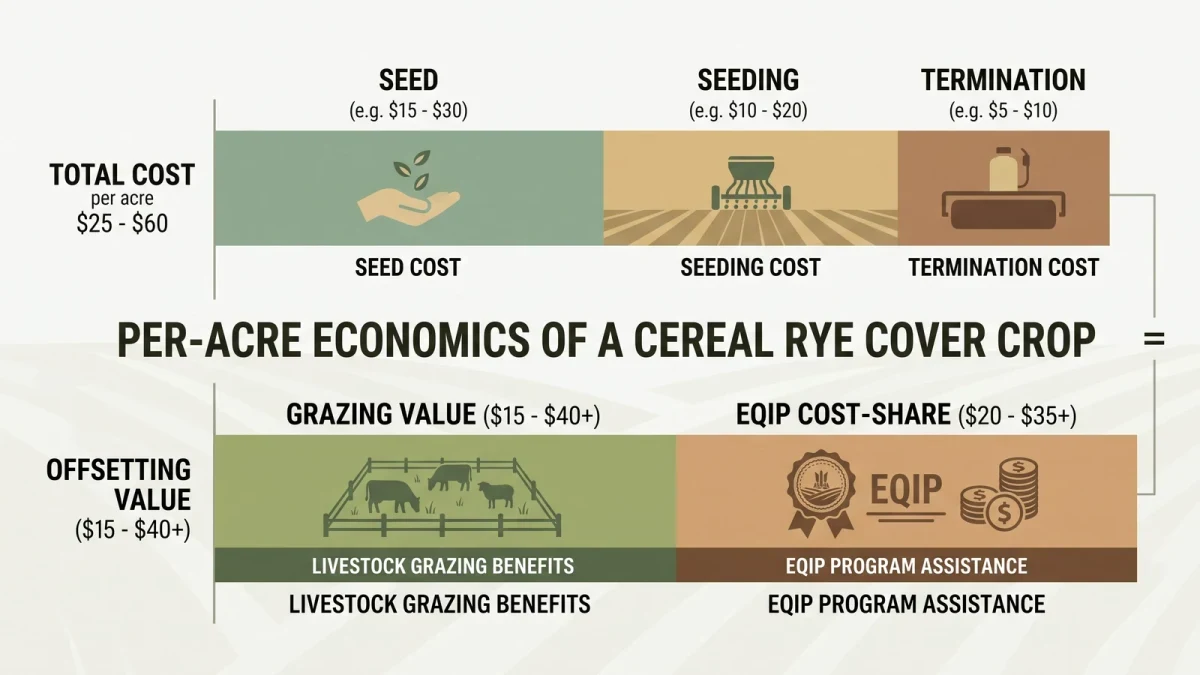
Cover crops cost most row-crop operations between $25 and $60 per acre in direct expenses, seed, seeding, and termination combined, according to university extension budgets from the Corn Belt, with USDA's 2022 Census of Agriculture counting 18 million acres of cover crops nationwide, up roughly 17 percent from 2017. Whether that spend pays depends on the specific job the cover crop is hired to do: erosion control, weed suppression, or grazing.
Farm Press Theme publishes information, not agronomic or financial advice. Cost figures below are documented ranges with their sources and regions; every field adds its own yield history, herbicide program, and weather to the math.
What goes into the cost of a cover crop stand?
Three line items make up nearly all of the direct cost. Seed is the largest: cereal rye, the workhorse species across the Midwest and Plains because it germinates in cold soil and scavenges residual nitrogen, typically costs in the range of $10 to $25 per acre at common seeding rates, per extension budget estimates from universities including Iowa State, Purdue, and Ohio State through 2025. Legumes like crimson clover and vetch seed out higher; multi-species mixes can push seed alone past $30 per acre.
Seeding is the second line item. Drilling costs more per acre than aerial or high-clearance broadcast application, but placement and stand consistency are better. Custom rates for either method vary by region; the Iowa State University custom rate survey is the standard regional reference. Termination is the third: a burndown herbicide pass, or the equipment cost of rolling or terminating green ahead of planting.
Where does the money come back?
Extension economists frame cover crop returns three ways, and conflating them is the most common budgeting error.
First, cost reduction that shows up on another line. Cereal rye ahead of soybeans suppresses marestail and waterhemp, and some operators document a lighter residual herbicide program over time. Over years, covers that build soil structure and protect against erosion preserve productivity on sloped ground, a return that shows up as yield stability rather than a single-year bump.
Second, new revenue. Grazing cover crops turns a cost center into forage: university forage estimates commonly value a good rye or turnip stand at grazing rates worth $30 or more per acre of feed replaced, offsetting much of the establishment cost where fencing and water allow. Second, the agronomic ledger: nitrogen credit from legumes, measured in fertilizer replacement per university trials, though the credit depends on termination timing and the following crop.
Third, program payments. USDA conservation programs, including the Environmental Quality Incentives Program (EQIP) under the 2018 Farm Act as continued into 2025, pay cost-share for cover crop establishment; payment rates and ranking vary by state and county. Some states add their own incentives, and a growing number of supply-chain programs pay per acre for documented practice adoption. Farmers should verify the payment amount and contract terms at their local USDA service center before counting it.
How long before a cover crop pays?
University trials give an honest, unwelcome answer: single-year returns are often negative when the only benefit counted is the following cash crop's yield. Multi-year studies, including long-term trials at universities such as Iowa State, Purdue, and Penn State, generally find the economics improve as soil benefits compound and as operators gain experience seeding and terminating effectively. Producers who graze the stand or capture program cost-share routinely close the gap in year one; pure grain operations without erosion exposure take longer.
The practical budgeting move is to write the cover crop into the rotation's worst-performing acres first, where erosion or herbicide-resistance pressure is documented, rather than spreading it evenly across the whole farm.
What did the 2022 Census of Agriculture show?
The census, the most complete count available, recorded 18 million acres of cover crops in 2022, up about 17 percent from 2017 despite total cropland declining. Adoption is heavily concentrated in the Corn Belt, the Chesapeake Bay watershed, where state cost-share programs pushed acres, and the southern Plains grazing belt. The census counts acres, not reasons, but the regional pattern matches where either water quality programs or cattle are present.
Which mistakes cost the most money?
Two failure modes dominate extension accounts of covers that lost money. The first is a multi-species mix planted for its catalog appeal: expensive seed, unclear purpose, poor stand. The second is late seeding into a short fall window, which produces a thin stand that costs the same but delivers little biomass. The operators with the best documented economics overwhelmingly plant a single inexpensive grass, cereal rye, at adequate rates, early, before harvest where possible.
| Cost component | Typical range per acre | Notes |
|---|---|---|
| Seed (cereal rye) | $10-$25 | Rate and price dependent; legumes and mixes cost more |
| Seeding (drill or broadcast) | $12-$25 | Drilling costs more, stand reliability higher |
| Termination | $5-$15 | Burndown pass or rolling; excludes residual program |
| Total direct cost | $25-$60 | Extension budget ranges, Corn Belt, through 2025 |
Frequently asked questions
How many acres of cover crops are planted in the U.S.?
About 18 million acres, per the USDA 2022 Census of Agriculture, up roughly 17 percent from 2017. Adoption is concentrated in the Corn Belt, Chesapeake Bay states, and southern Plains grazing regions.
What is the cheapest cover crop to plant?
Cereal rye is the least expensive dependable option across most of the country, with seed typically $10 to $25 per acre, per university extension budgets. It germinates in cold soil, overwinter reliably, and terminates cleanly ahead of soybeans or corn.
Do cover crops pay for themselves in one year?
Usually not on yield alone. Single-year returns are often negative in university trials; grazing, program cost-share such as EQIP, or documented herbicide savings are what typically close the gap in year one.
Does USDA pay for cover crops?
Yes, EQIP and related conservation programs offer cost-share for cover crop establishment, with rates and ranking set state by state. Verify the payment rate and contract terms at the local USDA service center; enrollment windows and caps apply.
Can you plant corn after cereal rye?
Yes, but termination timing matters: most university guidance terminates rye 10 to 14 days ahead of corn planting to limit nitrogen tie-up and allelopathy risk, while soybeans tolerate planting green into standing rye more readily.