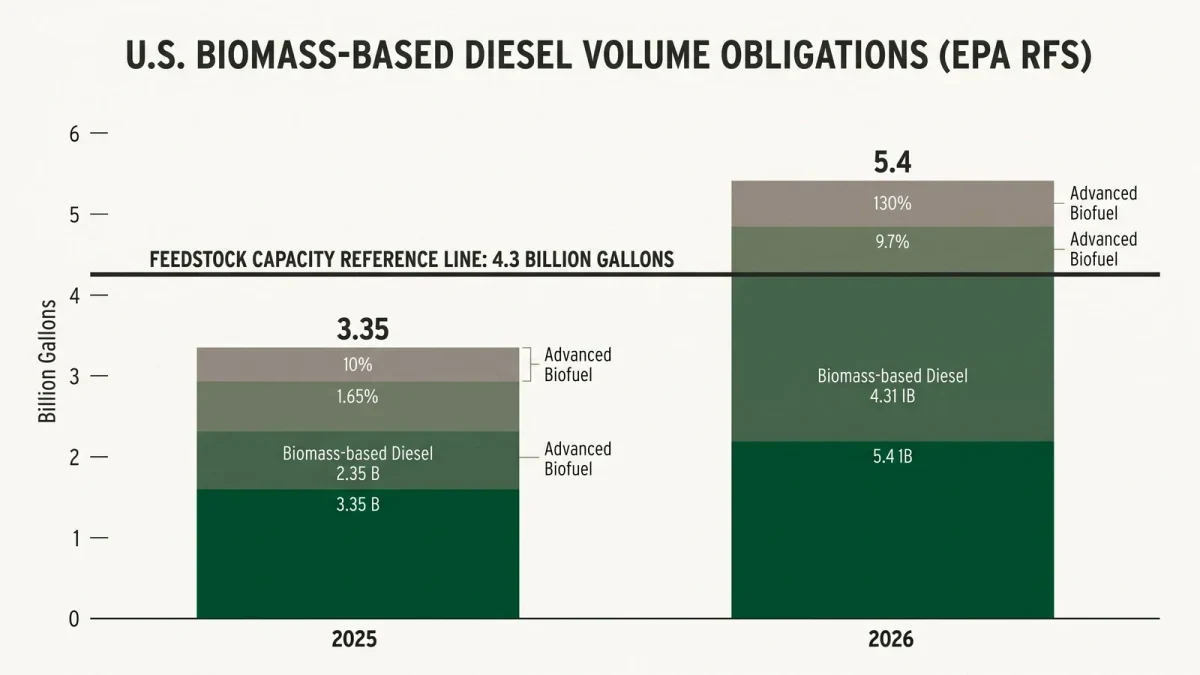
Renewable diesel's feedstock pull just got a policy-sized bump: the EPA finalized the 2026 biomass-based diesel Renewable Volume Obligation at roughly 5.4 billion gallons, up from 3.35 billion in 2025, per the Iowa Soybean Association's summary of the final rule. U.S. domestic feedstocks — soybean oil, tallow, used cooking oil and canola together — could currently support about 4.3 billion gallons of biomass-based diesel output, per Terrain Agricultural Analytics, leaving a documented gap between the target and the raw material.
Why does the RVO matter to soybean growers?
The Renewable Volume Obligation sets how much biomass-based diesel oil refiners must blend, and soybean oil has been the feedstock carrying the growth: slightly less than half of renewable diesel feedstock use in recent years, per USDA Foreign Agricultural Service analysis. A 5.4-billion-gallon obligation at that share implies demand for materially more soybean oil than the domestic crush was supplying when the rule was finalized. That pressure shows up in two places growers watch — soybean oil prices, which biofuel demand now anchors, and the crush margin that elevator bids track. The record crush reported through 2025 and into 2026, per AgWeb market reporting, is the industry's answer so far.
Where does the feedstock gap come from?
Arithmetic. Domestic feedstocks support roughly 4.3 billion gallons, per Terrain's analysis, against an obligation near 5.4 billion — so blenders either import more feedstock (tallow and used cooking oil imports have already reshaped trade flows, per the same USDA FAS analysis), bring additional feedstock online, or lean on biodiesel and renewable diesel imports with their own compliance value. Terrain also cautioned that soybean oil demand could be limited in the first half of 2026 as plants ramped and queued feedstock contracts — meaning the gap fills unevenly through the year rather than all at once.
What does this mean at the farm gate?
For soybean growers, the RVO strengthens the demand floor under crush and, through it, under basis at crush-adjacent elevators; the documented consequence of the past two biofuel buildouts is that crushers bid harder for nearby bushels when policy demand firms. Two cautions belong beside that. Feedstock competition cuts both ways for livestock and poultry operators: the same soybean oil demand supports meal supply as crush expands, but tallow and used-cooking-oil buyers now bid against renderers' traditional customers. And policy-set demand is policy-reversible on paper — the 2027 RVO process is the next scheduled decision, and forecasts of it belong to USDA and EPA, not to this site.
Frequently asked questions
What is the 2026 biomass-based diesel RVO?
About 5.4 billion gallons, finalized by the EPA, up from 3.35 billion gallons in 2025 — a roughly 60 percent increase, per the Iowa Soybean Association's summary.
Can U.S. feedstocks supply that volume?
Not yet on their own. Domestic feedstocks could support about 4.3 billion gallons of biomass-based diesel, per Terrain Agricultural Analytics, implying more imports or additional feedstock supply.
How much soybean oil does renewable diesel use?
Soybean oil supplied slightly less than half of renewable diesel feedstock use in recent years, per USDA Foreign Agricultural Service analysis, and record crush followed the demand.