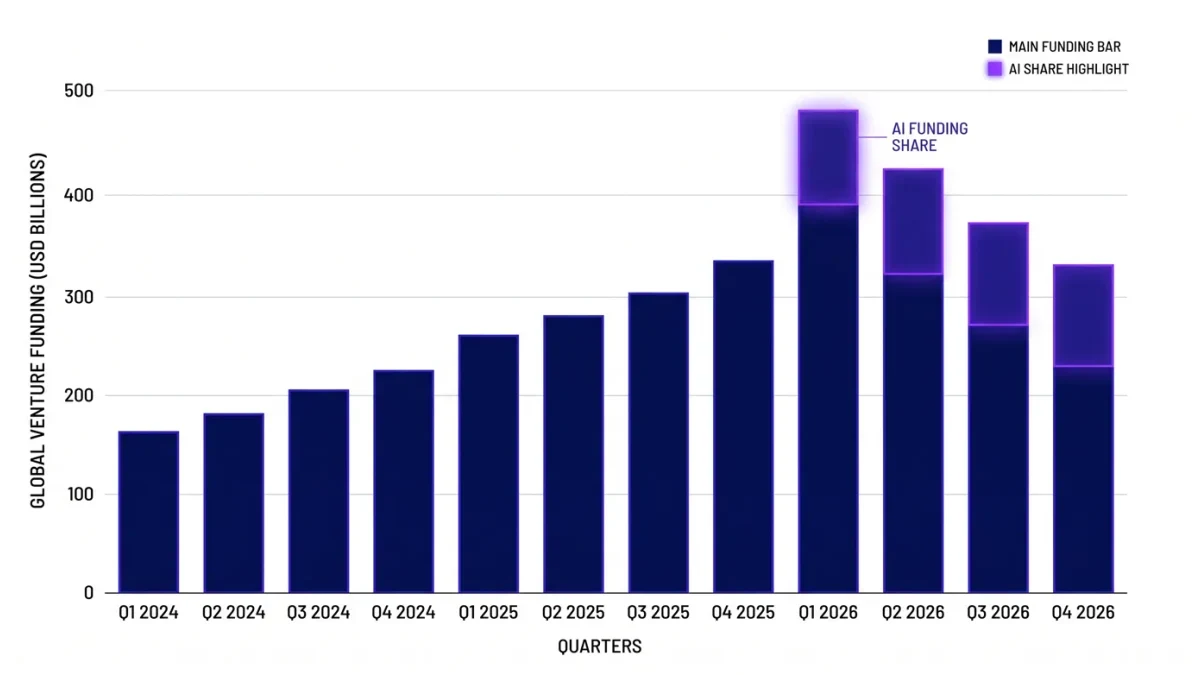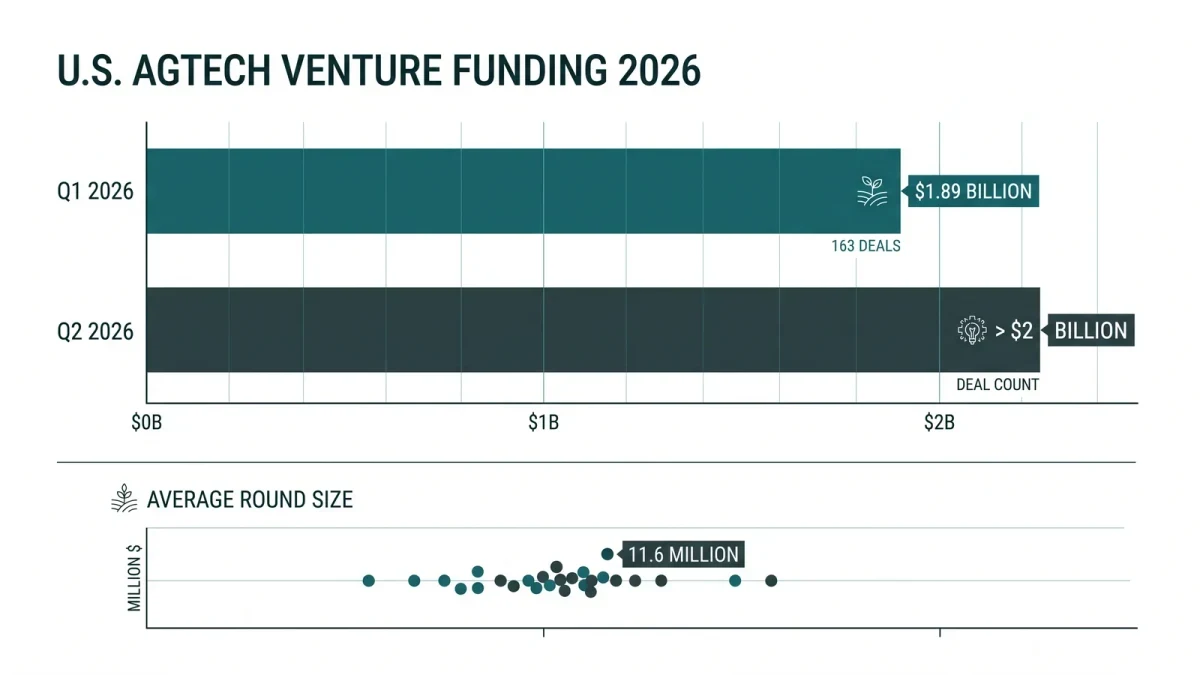
Agtech venture funding is running level but lopsided. Some 163 agtech startups raised a combined $1.89 billion in the first quarter of 2026, per CropLife's quarterly venture round-up, and Q2 topped $2 billion, per the Global AgTech Initiative's tally — roughly $4 billion in the first half, against a global agrifoodtech total that AgFunder's annual report put at $16.2 billion for 2025, flat year over year. The average Q1 round of about $11.6 million tells the real story: mid-size deals in favored categories, not a broad rebound.
Where is the money going?
Not evenly. Agriculture captured just 0.57 percent of total global venture capital deployed in Q1 2026, per Delphos capital-market analysis — a reminder of how thin the funding layer over farming remains. Within that slice, AgFunder's 2026 report found the flat top-line total masking sharp shifts by category: dollars concentrated where revenue stories are shortest, while longer-horizon fields thinned out. For operators, the practical read is which vendor categories keep fresh capital behind them — because a subscription platform's funding runway is part of its service reliability, whether or not the contract says so.
What does steady-but-flat funding mean for farm technology buying?
Three consequences at the farm gate. First, vendor durability is the due-diligence question: a precision-ag or farm-management subscription bought in 2026 is a bet on the company surviving to 2029, and half-year funding news is public signal of who has the runway. Ask any prospective vendor directly about funding stage and runway, and treat evasive answers as data. Second, the mid-size average round favors tools with clear payback — guidance, imagery, field-data infrastructure — over moonshots, so the tooling available to operators keeps improving at the practical end. Third, university and USDA channels stay important where venture money is not: federally funded research and extension remain the documented source for unbiased trial results, and federal grant programs continue to fund agricultural innovation outside the venture cycle.
Is the slowdown over?
Not exactly — level is the honest word, per the numbers above. The 2025 global agrifoodtech total of $16.2 billion matched the prior year, and H1 2026's U.S. agtech pace likewise ran close to flat against the back half of 2025. What changed is composition, not volume. Operators should read that as continued availability of funded vendors, continued churn among underfunded ones, and no return to the 2021-era flood that produced tools which outlived their makers.
Frequently asked questions
How much did agtech raise in the first half of 2026?
About $1.89 billion in Q1 across 163 startups, per CropLife's round-up, and more than $2 billion in Q2, per the Global AgTech Initiative — roughly $4 billion combined.
Is agrifoodtech funding growing?
Globally it was flat at $16.2 billion in 2025, per AgFunder's annual report, with the mix shifting between categories rather than the total expanding.
Why should a farmer care about VC numbers?
Because subscription and precision tools depend on the vendor staying in business. Funding stage and runway are fair questions to ask before signing multi-year farm-data or equipment-software contracts.