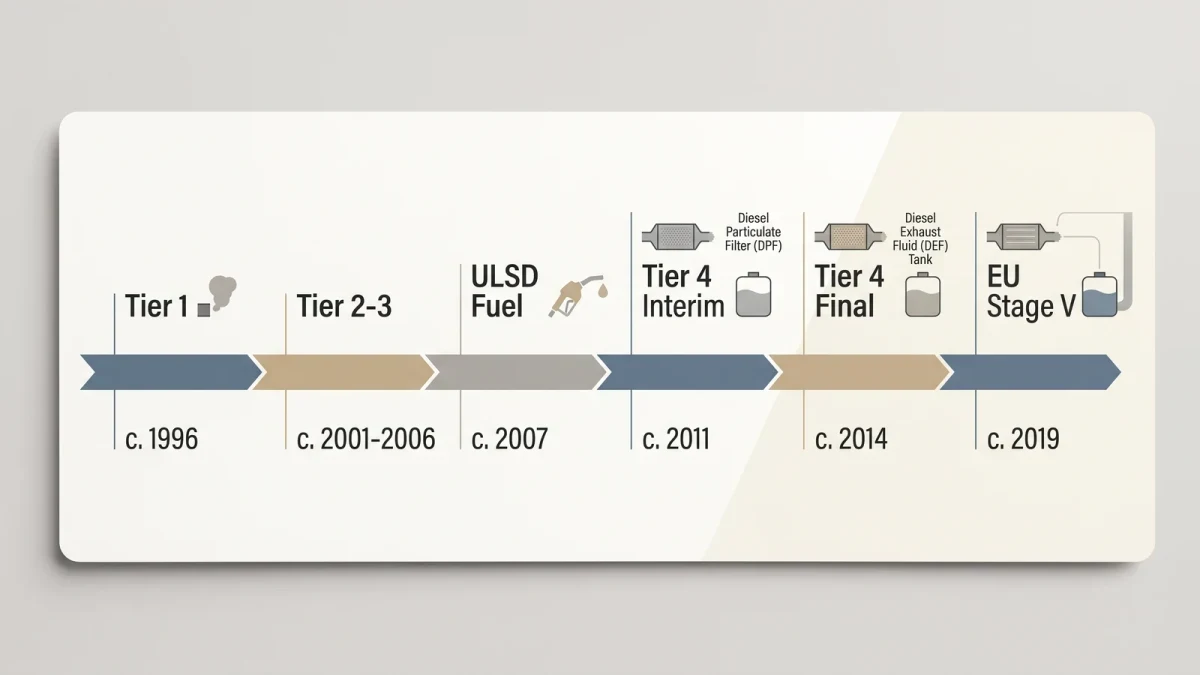
Tractor emissions regulation in the United States is a three-decade escalation built on one statute and one fuel change: the Clean Air Act nonroad diesel program cut oxides of nitrogen and particulate matter from new diesel engines by more than 90 percent between the first Tier standards in the 1990s and Tier 4 Final, fully in effect since 2014, per the U.S. Environmental Protection Agency. Europe's Stage V rules, in force since 2019, added particle-count limits that now shape what global manufacturers build for every market, including ours.
Farm Press Theme publishes information, not compliance advice; emission-plan questions for a specific fleet belong with the state agency or the dealer's certification paperwork. The timeline below is the documented backbone every such conversation starts from.
What did each Tier standard actually require?
Congress directed EPA to regulate nonroad diesel engines in the 1990s, and the agency phased standards in by horsepower class. Tier 1 arrived with the 1996 through 2000 model years, Tier 2 and Tier 3 followed across roughly 2000 to 2008, and Tier 4 — the step change — rolled in two stages: Tier 4 Interim from about 2008 to 2012 and Tier 4 Final from 2014, per EPA's nonroad diesel program documents. The Tier 4 rules used a two-part toolset: ultra-low-sulfur diesel fuel, capped at 15 parts per million for nonroad equipment by 2010, and aftertreatment hardware — selective catalytic reduction fed by diesel exhaust fluid, plus diesel particulate filters. Together, per EPA, the program removes more than 90 percent of NOx and PM from new nonroad diesel engines compared with unregulated predecessors.
How does Europe's Stage V change what sits in the dealer lot?
Stage V, applied to new engines sold in the European Union from 2019 and 2020 by category, tightened particulate limits to the point that a diesel particulate filter is effectively mandatory even on smaller diesels, and it brought additional engine categories — smaller outputs and some spark-ignition units — under numeric limits. Because major tractor makers engineer one platform for global markets, Stage V-era machines sold in the United States largely carry Stage V-equivalent hardware even where EPA does not require it. The operator-visible difference on those machines: more exhaust plumbing, more sensors, and regeneration behavior to manage in the field.
What does California require that other states do not?
The California Air Resources Board runs its own, stricter regime under a federal waiver. Its In-Use Off-Road Diesel-Fueled Fleets Regulation covers diesel equipment over 25 horsepower operated in California, and rather than policing individual engines it holds fleets to average emission targets that tighten over time, with reporting, labeling, and turnover requirements. CARB has since layered on rules targeting spark-ignition equipment and, separately, fleet electrification proposals for the construction sector; agriculture's exposure runs mainly through the off-road diesel fleet rule and portable equipment registration. An operator with equipment crossing into California should verify current requirements with CARB directly, since the rules amend frequently.
What are the documented milestones?
The sequence below compresses the record into one table; each row is traceable to the agency named in the timeline section above.
| Years | Rule or standard | What changed for tractors |
|---|---|---|
| 1996-2000 | EPA Tier 1 | First numeric NOx, PM and hydrocarbon limits on new nonroad diesel engines |
| 2000-2008 | EPA Tier 2 and Tier 3 | Steadily tighter limits by horsepower class; engine tuning and some combustion changes |
| 2007-2010 | Nonroad ULSD transition | Diesel for farm equipment capped at 15 ppm sulfur, enabling aftertreatment |
| 2008-2012 | Tier 4 Interim | Particulate filters and exhaust gas recirculation appear on larger engines |
| 2014 | Tier 4 Final | Full SCR with diesel exhaust fluid; NOx and PM down more than 90 percent from pre-Tier baselines |
| 2019-2020 | EU Stage V | Particle-number limits; DPF effectively universal; global platforms built to it |
What does the timeline mean for fleet decisions?
Three consequences follow from the record. First, the used market is stratified by emissions tier, and pre-Tier 4 iron holds value in applications where aftertreatment is a liability — livestock buildings, short-hour duty — while Tier 4 machines price with their service history, especially DPF and SCR maintenance records. Second, operating cost changed shape rather than simply rising: diesel exhaust fluid is a real line item now, roughly a few percent of fuel volume, and improper handling or running a machine out of DEF converts into derating and repair bills, per manufacturer documentation. Third, compliance geography matters. A fleet that works in California, or sells across state lines, carries record-keeping obligations that a Nebraska-only operation does not.
Could the rules change again?
Any honest answer has to separate the settled from the open. Tier 4 and Stage V are embedded in the installed base and will not unwind. What is genuinely open, as of March 2026, is the next layer: EPA and CARB attention has shifted toward zero-emission pathways for some off-road categories and toward greenhouse gas accounting that reaches beyond the engine. Those processes move through proposal and comment periods, and nothing in them changes a tractor bought this spring. The practical stance for an operator is to keep exhaust-system documentation with each machine's records — it is the paper that any future rule, resale, or cross-state move will ask for.
Frequently asked questions
Do emissions rules apply to used or older tractors?
Tier standards applied to new engines at manufacture, so existing machines were never forced to retrofit under federal rules. California's fleet rule is the exception that reaches in-use equipment through fleet-average turnover requirements.
What is DEF and why do Tier 4 tractors need it?
Diesel exhaust fluid is a urea solution injected into the selective catalytic reduction system to convert NOx to nitrogen and water. Running out triggers derating, so it is an operating cost and a workflow item, not an option.
Do Stage V rules apply in the United States?
No. Stage V is European law. But global manufacturers build one platform for both markets, so many U.S.-sold machines carry Stage V-equivalent hardware beyond what EPA requires.
Where does a California operator start?
With CARB's In-Use Off-Road Diesel-Fueled Fleets Regulation for equipment over 25 horsepower: reporting, labeling and fleet-average targets. Verify current requirements with CARB, since the rule amends frequently.
Did Tier 4 raise fuel costs?
ULSD costs more to refine than the high-sulfur fuel it replaced, but Tier 4 engines generally match or improve fuel efficiency per unit of work, per manufacturer documentation. The bigger new costs are DEF and aftertreatment maintenance.