USDA Rural Development's Value-Added Producer Grant program funds up to $250,000 for working capital and $75,000 for planning on projects that turn farm commodities into processed products — the federal marker of how established the value-added channel has become. Whether processing pays on a given farm is a separate question, answered by a break-even built on documented throughput, capture of the marketing margin, and the compliance costs that raw sales never carry.
Farm Press Theme publishes information, not financial advice; grant rules and program figures below are stated with their agency and as-of dates.
What counts as value-added, and what does it capture?
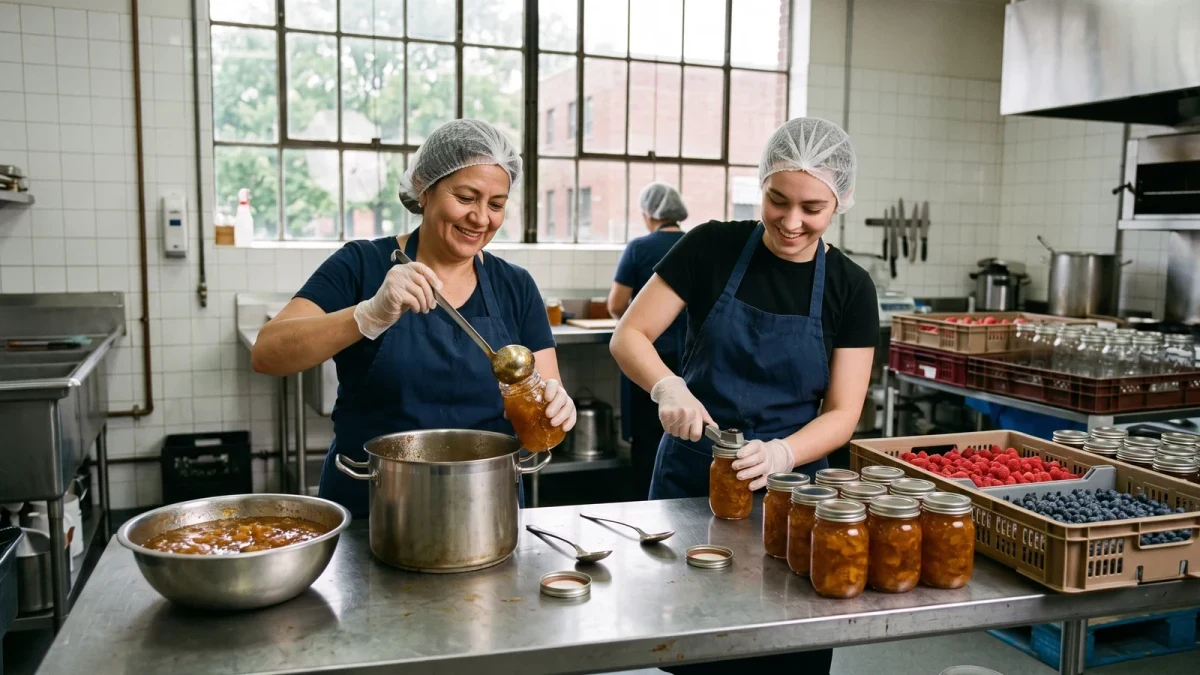
Value-added processing is the conversion of a raw commodity into a form worth more per unit of raw input: corn into tortillas, milk into cheese, wheat into flour, fruit into jam. The economic logic is capturing the processing and marketing margin that mid-chain firms otherwise take, plus any premium from branding, local labeling, or differentiated attributes.
The margin capture is real but not automatic. The farm takes on the processor's cost structure — equipment depreciation, packaging, labor, food-safety compliance, and distribution logistics — and earns the processor's margin only if volume and price cooperate. USDA's program design acknowledges the difficulty: it channels planning money first, because the agency's own framework expects feasibility work before capital commitment.
What does the break-even math look like?
The break-even question has two layers. Unit break-even: price per packaged unit minus variable cost per unit — ingredients at farm-gate value, packaging, direct labor, label, and freight. Capacity break-even: the number of units per year needed to cover fixed costs — equipment, inspection and licensing, insurance, and the owner's management time charged honestly.
A practical discipline from extension feasibility guidance: project the operation at a conservative fraction of planned sales for the first two years, because distribution takes longer to build than processing capacity. A value-added plan whose break-even sits above realistic first-year volume is a plan to inventory product, not to capture margin.
Which costs surprise value-added beginners most?
Three recur in feasibility studies and regulatory guidance. Food-safety compliance: processed food sold across state lines engages federal labeling and safety rules, and even intrastate sales face state licensing and inspection — costs that scale with SKU count and facility type. Distribution: perishable processed product usually needs refrigerated logistics that raw commodity sales never required. Labor: processing is labor-intensive per dollar of revenue, and the owner's own hours belong in the calculation at a real wage.
- Licensing, inspection, and recalls insurance vary by product and state — budget them before the first batch.
- Packaging and label compliance is per-SKU; every added product multiplies the cost.
- Cold-chain and shelf-life constraints cap the sales radius until volume justifies logistics spend.
How do grants and programs change the math?
Grants change the capital curve, not the market. The Value-Added Producer Grant — administered by USDA Rural Development, with the $250,000 working-capital and $75,000 planning caps as of the 2025 program year — covers a share of project costs and requires matching funds, meaning the farm's own money stays in the project regardless. Other documented supports include state agricultural diversification programs and, for some producers, cooperative structures that share processing capacity across member farms to reach capacity break-even faster.
The honest framing: a grant-funded project still has to clear unit and capacity break-even on its own sales. Grants buy time and reduce early debt, which improves the survival odds of a plan that already works on paper.
When does value-added clearly pay, and when does it not?
It most often pays where the raw commodity is a small share of the finished product's price — jams, cheese, baked goods, cosmetics-adjacent oils — and where the operation already has direct-market access to capture the retail margin. It most often fails where the processed product competes head-on with commodity processors at their scale, or where the farm cannot staff the processing line and the sales channel at once.
The two-entry test: run the enterprise budget for the processing enterprise separately from production, charge the raw commodity at its market value rather than at cost, and let the second ledger say whether the processing business is profitable or a subsidy from the farming business.
Frequently asked questions
How much can a Value-Added Producer Grant award?
Up to $250,000 for working capital and $75,000 for planning activities per the USDA Rural Development program, with matching-fund requirements applying. Program terms are announced annually; confirm the current notice before applying.
Should raw commodity be charged at cost in the processing budget?
No. Charge it at its market farm-gate value. Valuing your own commodity at cost hides whether the processing step adds margin or quietly consumes the production enterprise's profit.
What is the biggest hidden cost in on-farm processing?
Compliance and logistics: licensing, food-safety planning, labeling rules, and refrigerated distribution. These costs do not exist in raw commodity sales and scale with the number of products and the sales radius.
Is value-added processing a good diversification strategy?
It can be, when the finished product captures a real marketing margin and the farm can staff both production and processing. It fails when the product competes with large processors on their terms. A separate enterprise budget for the processing business is the deciding evidence.