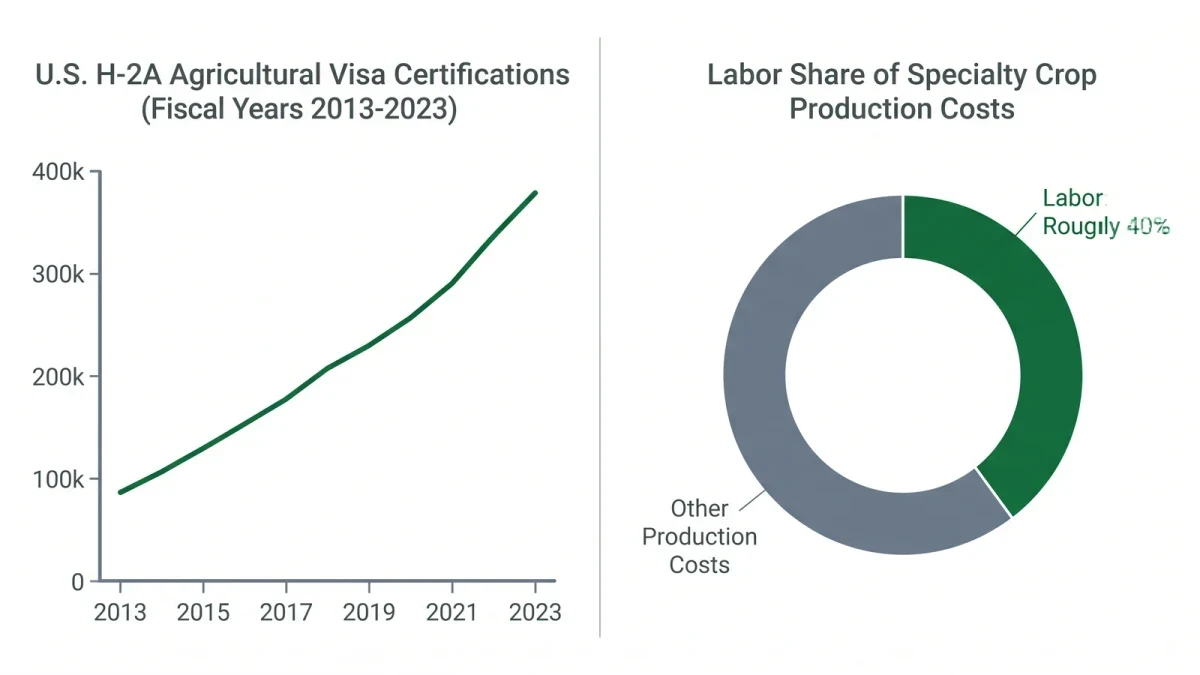
Labor is the largest single production cost in U.S. specialty crops, typically around 40 percent of total production costs for hand-harvested fruit and vegetable crops, per USDA Economic Research Service analyses. The workforce behind it is overwhelmingly seasonal and foreign-born, and its main legal channel keeps growing: employers requested roughly 379,000 H-2A agricultural visa positions certified in fiscal year 2023, per Department of Labor employment and training administration data, up from under 100,000 a decade earlier. When that labor is short or more expensive, the fresh produce section prices it first.
This site publishes information, not legal advice, and immigration law is its own specialty. The economics, though, are food-system economics, and they connect berry prices, apple bins, and lettuce rows to a single labor market that farm operators plan around every season.
Why are specialty crops so labor-dependent?
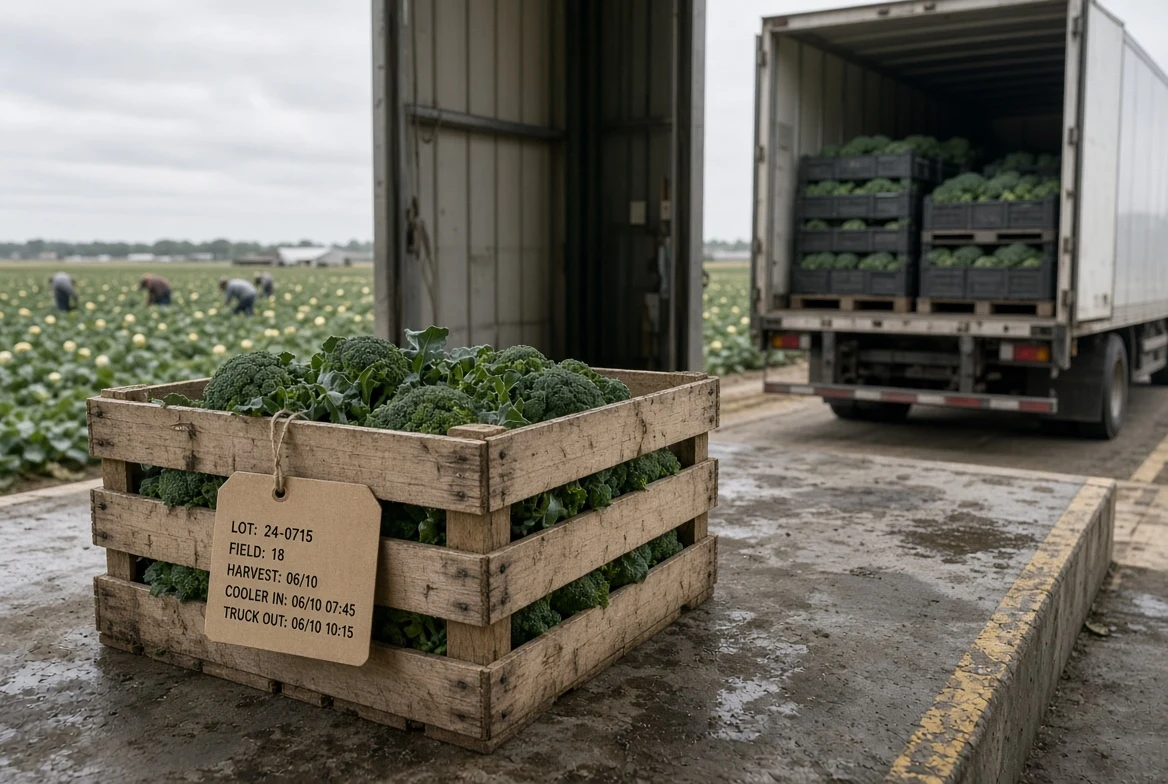
Specialty crops, fruits, vegetables, tree nuts, and nursery crops, unlike grains and oilseeds, never completed the mechanization transition. Bulk commodity crops are harvested by machine because a bushel of corn is a uniform, durable object; a strawberry is soft, ripens unevenly, and sells by appearance. Crops like apples, berries, melons, lettuce, asparagus, and table grapes are picked by hand, often several times per field per season, by crews working at piece or hourly rates.
That means the harvest cost is baked into the crop choice itself. USDA analyses put labor near 40 percent of production costs for many hand-harvested crops, and higher for berries. Mechanization is advancing selectively, but as of 2026 the majority of U.S. fresh produce acres are still picked by people.
What is the H-2A program and why does it keep growing?
The H-2A visa program lets U.S. employers hire foreign workers for seasonal agricultural jobs when domestic workers are unavailable, after recruiting attempts and a labor certification process. Employers must pay the Adverse Effect Wage Rate, a state-specific wage floor set annually by USDA and the Department of Labor that in recent years has run well above minimum wage and risen faster than general wages in many states, plus provide housing and transportation under Department of Labor rules.
The program's growth is the clearest documented signal of the labor market. Certified positions rose from under 100,000 in the early 2010s to roughly 379,000 in fiscal 2023, per Department of Labor data, with the heaviest concentrations in California, Washington, Florida, Georgia, and North Carolina. An increasing share of the fresh produce workforce now arrives through this single, rule-bound channel, so wage rates, housing inspections, and paperwork timelines in one federal program now move harvest outcomes nationally.
How does labor cost reach the grocery shelf?
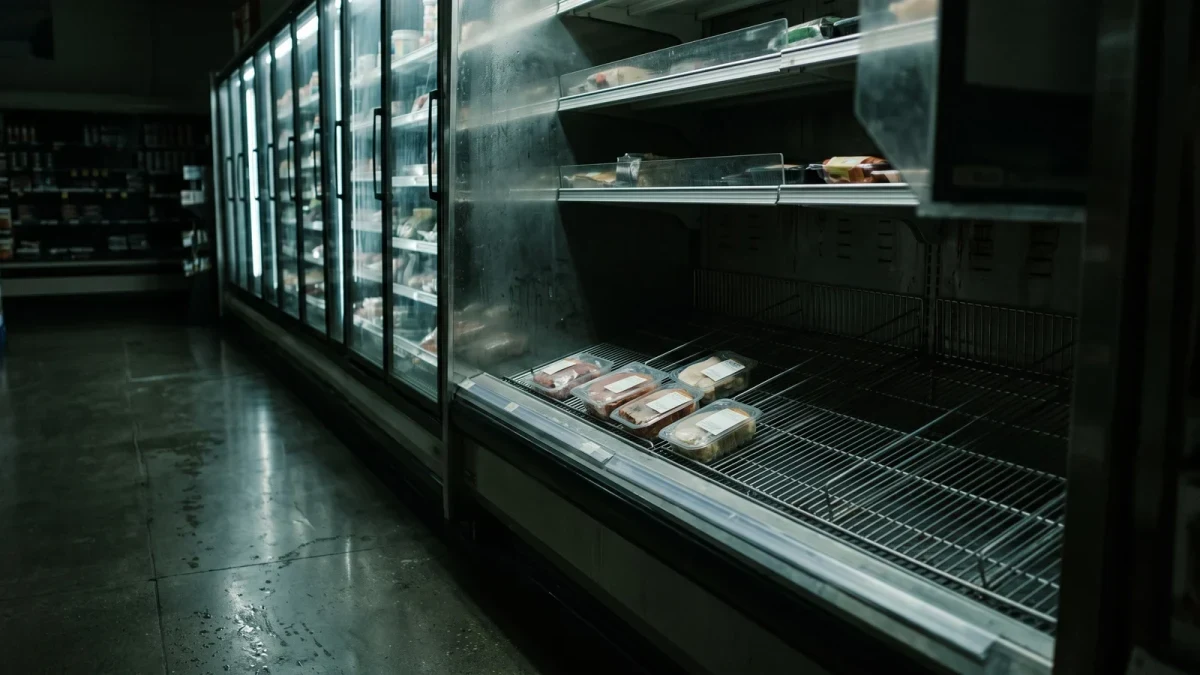
Through supply and through price floor. When labor is short at harvest, crops are picked late or not at all, reducing supply and raising prices; documented examples in recent seasons include California growers discarding portions of some crops they could not staff. When labor is fully priced, the rising Adverse Effect Wage Rate and housing costs raise the cost of harvest, and thin retail margins pass much of it through. Perishability limits the usual cushions, no storage year for strawberries, so labor shocks show up in the produce case within weeks.
Import substitution is the release valve. Fresh produce imports from Mexico and Central America, where harvest labor costs less, now supply a large share of U.S. winter produce, and U.S. growers of labor-intensive crops compete with that cost base directly. The more domestic labor costs rise, the more import share grows in the crops where quality tolerates the truck ride.
What are growers doing about it?
The documented playbook has four parts. Raise labor productivity, using harvest platforms, conveyor systems in the field, and orchard redesign, high-density plantings trained to fruiting walls that speed picking. Raise prices through varieties and branding that support higher cost floors. Shift acres toward less labor-intensive crops or machine-harvestable varieties where breeding allows. And use H-2A to secure crews, accepting its costs to buy reliability. USDA and university extension programs document all four in current production research.
What the industry has not found, despite serious investment, is a general-purpose harvesting robot. Machine vision and picking arms work in controlled environments and specific crops, and several commercial systems operate in apples and other crops, but the soft, fast, judgment-heavy work of most fresh harvest remains human.
What should food buyers and operators take from it?
The fresh produce aisle prices a scarce, legally complicated workforce before it prices weather. For growers, the planning variables are the Adverse Effect Wage Rate trajectory in their state, housing capacity for contract crews, and the mechanization path for their specific crops. For the broader food industry, specialty crop labor is a supply-chain dependency that behaves like infrastructure: invisible when it works, price-setting when it tightens. The 2023 certification figure near 379,000 positions is the size of the sector's most visible artery, and it has been growing every year on record.