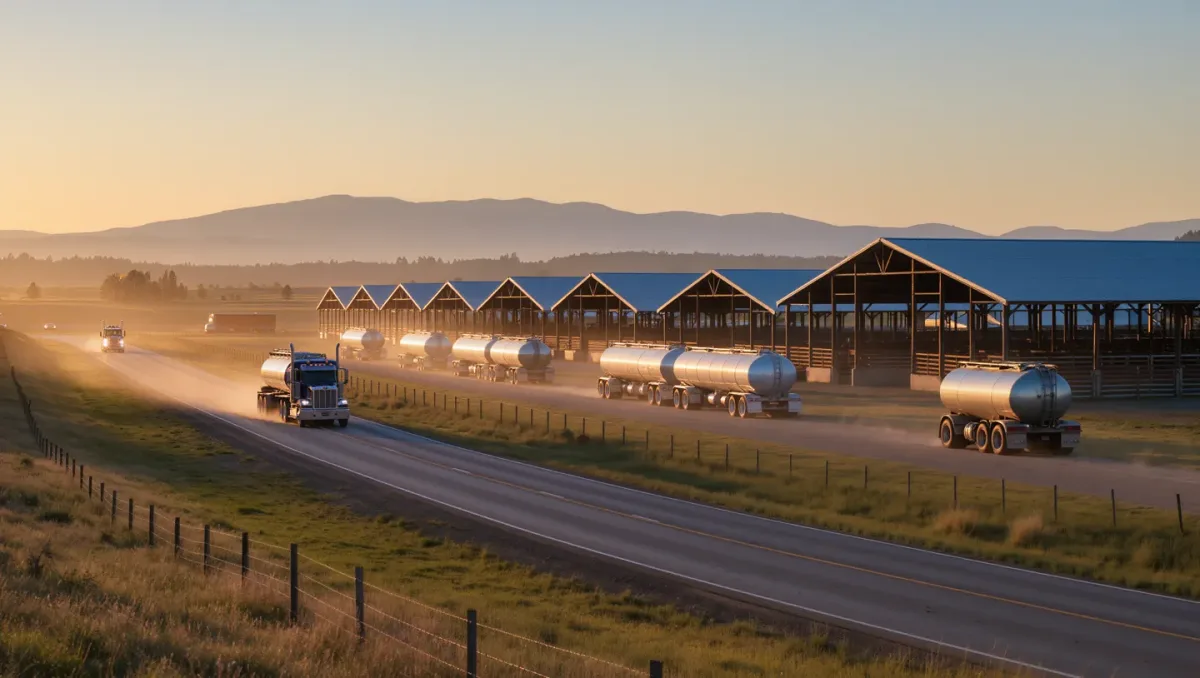
U.S. dairy processors have announced more than $11 billion in new and expanded manufacturing capacity across 19 states, per the International Dairy Foods Association's October 2, 2025 announcement, the largest capacity buildout the sector has documented. New York leads with $2.8 billion of announced investment, including Chobani's $1.2 billion processing facility, followed by Texas at $1.5 billion, Wisconsin at $1.1 billion, and Idaho at $720 million. The spending wave is the newest chapter of a consolidation story that has been running since the 1990s, and it moves milk economics by region.
This site publishes information, not marketing advice. What follows is the documented structure of dairy processing consolidation and its consequences for milk producers, drawn from industry announcements and USDA data. The pattern matters for any operation deciding where its milk will be worth the most over the next decade.
What does consolidation in dairy processing actually look like?
Consolidation has meant fewer, bigger, more specialized plants. Per USDA Economic Research Service analyses of the sector, the number of U.S. dairy processing plants fell steadily for decades while output per plant rose, concentrated in cheese, whey products, butter, and powder. The plants that survived are not generalists: they are mozzarella lines sized for national food service demand, whey-protein refineries riding the protein ingredient market, and large-scale cultured and fluid operations serving retail contracts.
The scale logic is standard manufacturing. Big specialized lines run cheaper per pound of product, hold tighter specifications, and justify the food safety and automation investment that smaller mixed plants cannot amortize. The cost is geographic: when the local plant closes, the local milk premium closes with it.
Why did the building phase start now?
Demand composition shifted. Domestic consumption of dairy fat and protein components, cheese and whey especially, kept growing while fluid milk consumption kept its long decline, so the industry has been short of the right kind of capacity, cheese vats and dryers, in the regions where milk is growing. IDFA's accounting shows the announced projects concentrated exactly there: the Texas panhandle and southwestern plains, Idaho's magic valley, Kansas, and upstate New York, places where either milk production is expanding or large local demand anchors the plant.
Chobani's $1.2 billion New York facility is the largest single project in the IDFA list, and its location in a state with tightening raw-milk supply illustrates the other driver: processors are siting capacity to secure future milk, not just to follow it. Industry coverage through the period described processors competing for milk supply relationships in growth regions, effectively recruiting farms.
What does consolidation do to farm-gate milk prices?
Three documented effects. First, basis by region widens in favor of milk near scarcity or new demand: milk close to a capacity-constrained plant commands a premium over milk hauling toward a surplus. Second, cooperative structure concentrates with the plants, since the co-ops that own the big processing assets pool member milk into them, and membership terms, basing, component differentials, and capital assessments, follow the plant's economics. Third, component pricing dominates outright volume, because cheese and whey capacity pays for butterfat and protein, not hundredweight.
The consequence is that the same national mailbox price moves less than it used to relative to location and components. A farm's milk check increasingly depends on which plant its milk can physically reach, and the consolidation map is therefore a milk-price map.
What are the risks in the buildout?
The honest risks run both ways. If the announced capacity arrives while domestic demand growth slows or trade access narrows, the sector can end up long on powder and cheese, and farm-gate prices pay for it, the classic post-expansion squeeze the industry saw after previous building cycles. Construction delays, permitting, labor for both construction and operation, and equipment lead times have already stretched project timelines in coverage through 2025 and 2026. Announced capacity, as always, is not operating capacity.
For milk producers in growth regions, the opportunity carries leverage questions: hauling distance, contract duration, and co-op equity commitments. For producers in regions without new capacity, the question is the mirror image, whether enough local demand remains to keep their plant open and their basis competitive.
What should milk producers take from the current phase?
Read the capacity map as a decade-scale planning input. Where plants are being built, milk demand will tighten and terms for farms near them improve; where plants are aging without reinvestment, the long-run risk is closure. The documented numbers to anchor on: more than $11 billion announced across 19 states as of the IDFA's October 2025 accounting, led by New York, Texas, Wisconsin, and Idaho. The buildout is the strongest signal in years about where the industry believes milk will come from, and it will reward producers whose location, components, and quality line up with what the new plants are built to buy.