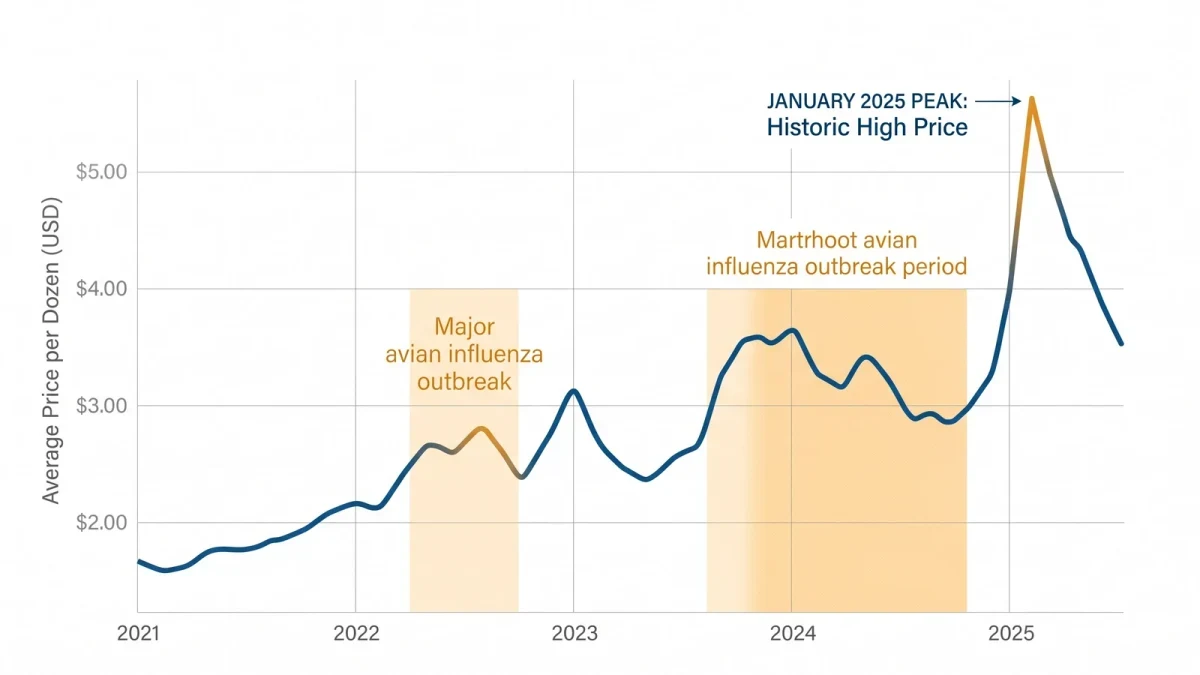
Egg prices swing harder than nearly every other grocery category because supply can collapse faster than demand adjusts. U.S. retail egg prices averaged $4.95 per dozen for Grade A large eggs in January 2025, per Bureau of Labor Statistics consumer price index data, after avian influenza removed roughly 40 million egg-laying hens during 2024, per USDA Animal and Plant Health Inspection Service outbreak records. No other staple combines that kind of supply shock with that kind of steady demand.
What follows is the documented mechanics of why the market moves the way it does, drawn from USDA data and the biology of the laying flock. The mechanics have repeated in every outbreak year since 2022, and they will shape the next cycle whatever it turns out to be.
What actually sets the price of a carton of eggs?
Eggs are one of the least processed foods on the shelf, so the farm-level price is a bigger share of the retail price than for most products. Wholesale prices for Midwest large eggs are discovered daily through USDA Agricultural Marketing Service market reporting, and retail follows wholesale with a lag of a few weeks. When the wholesale market spikes, carton prices spike; when it crashes, cartons drift down more slowly, because retailers reprice unevenly.
Demand, meanwhile, is famously inelastic. Eggs are a staple with few exact substitutes at the same price and function, and consumption is anchored by home baking and breakfast habits that do not re-price week to week. Small changes in available supply therefore produce large changes in price, because the quantity demanded barely moves.
How does avian influenza break the supply side?
Highly pathogenic avian influenza is lethal to poultry and spreads fast, so an infected commercial layer house is typically depopulated entirely, within days, to stop the spread. A single large complex can hold several million hens, which is why outbreak math is lumpy: one confirmed case can remove more hens in a week than months of ordinary culling and replacement.
The 2022 through 2025 outbreak years made this pattern national. Per USDA APHIS records, cumulative losses since 2022 ran well over 100 million birds across all poultry types, with table-egg layers hit hardest among the commercial sectors in the 2024 phase of the outbreak, when roughly 40 million layers were lost in that year alone. Migratory waterfowl carry the virus along flyways, so risk peaks in fall and spring migration, and a quiet summer can be followed by a brutal December.
Why can't producers just replace the hens quickly?
The laying flock has a biological clock. A pullet takes about five to six months from hatch to first egg, and hatchery capacity for layer breeds is limited and booked ahead. After a major depopulation, a complex must wait for available pullets or hatchery placements, biosecurity review, and sometimes regulatory clearance before it returns to full lay. Even at aggressive restocking, the supply response is measured in quarters, not weeks.
That lag is the engine of the price cycle. Prices spike while the flock is short, stay elevated while replacement pullets mature, then fall sharply once restocked flocks hit full production into demand that never fully left. Producers who lived through 2015, 2022, and 2025 recognize the shape even when the magnitude differs.
What else amplified the recent swings?
Two structural factors made the post-2022 cycles rougher than the 2015 one. First, a large share of the national layer flock is concentrated in a small number of very large complexes, so single outbreak events move national supply measurably. Second, some consumers shifted toward eggs as a relatively cheap protein during years of broad food inflation, keeping demand firm exactly when supply was shortest.
Retailer pricing strategy added a second layer. Because eggs are a high-visibility item shoppers use to judge a store's prices, some chains held carton prices below cost during spikes and let margins recover later, while others passed wholesale moves through quickly. The result was a wide gap between what different shoppers paid for the same dozen in the same week, and a disconnect between wholesale crashes and shelf prices that frustrated both consumers and producers.
What does the volatility mean for poultry and grain operators?
For layer operations, the cycle is a capital-survival exercise: hedging is limited, so the tools are biosecurity, insurance where obtainable, and balance sheets built to absorb a depopulation. For grain operators, the layer flock is a feed demand line item, and outbreaks move it: every million hens removed takes roughly a million-plus bushels of annual corn-equivalent feed demand with it, directionally pressuring local basis in heavy poultry regions.
For the food industry broadly, eggs are an ingredient in baking, pasta, mayo, and processed foods, and product reformulation away from shell eggs moves slowly. Egg products operations, which pasteurize and package broken-out eggs, run on the same flock math, so ingredient buyers face the same cycles as retail in a slightly damped form.
Is anything structurally different going forward?
Two documented developments are worth watching, without predicting outcomes. USDA approved a vaccine for use in laying flocks in 2025, per department announcements, though adoption, trade acceptance, and logistics remained open questions as of late 2025. And several large producers announced flock-expansion projects in 2025, which adds supply when completed but also adds exposure if the virus stays endemic in wild birds. Both change the parameters of the next cycle; neither repeals the biology.
The honest summary is that egg volatility is not a market failure so much as a market design. A perishable, inelastically demanded product produced by a biological process that can be emptied by disease in a week will price violently. The operators who do best in it are the ones who plan for the cycle instead of being surprised by it.