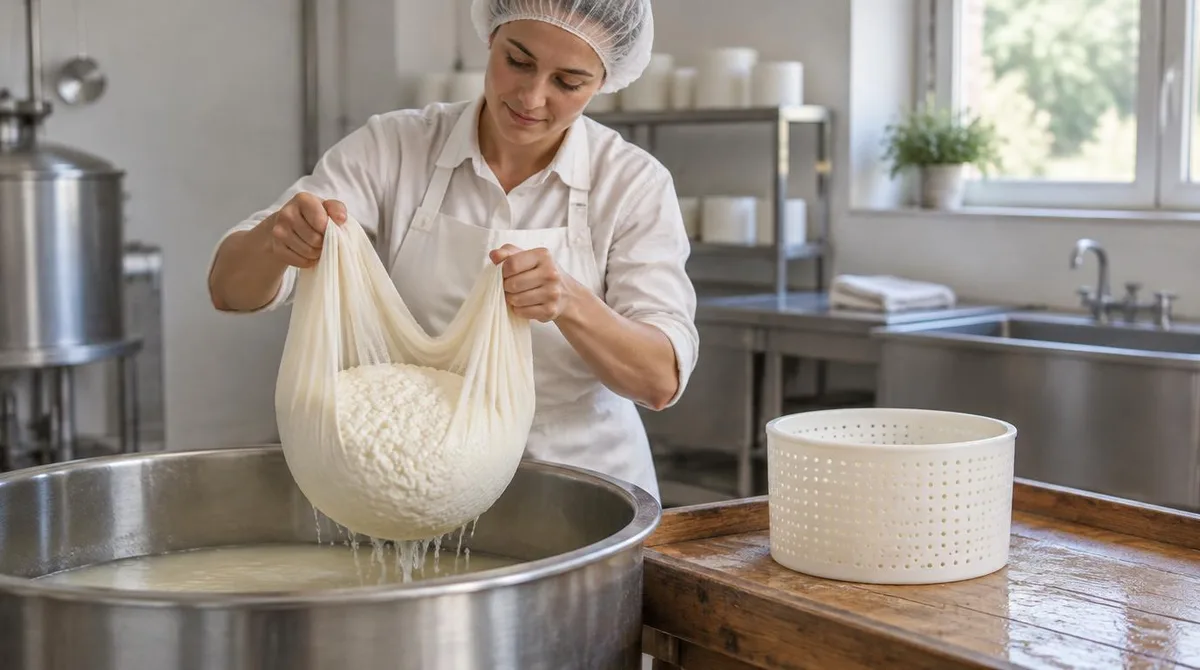
Cheese is made by curdling milk, draining the liquid whey from the solid curds, and pressing or aging what remains. Acid and an enzyme called rennet do the curdling; everything after that — salting, pressing, molding, aging — decides whether the result is a fresh tub of ricotta or a hard wheel of Parmesan.
The promise behind that simple sequence is preservation. Cheese keeps far longer than the milk it came from, which is why producers can store wheels and sell when markets turn favorable rather than the day the cow is milked. For a farm business, that storage option is the whole point of the exercise.
This walkthrough follows the process in order, from the milking parlor to the aging room, and flags where each step changes the economics as well as the flavor. If you want the wider commercial picture, the food section tracks what happens to product after the farm gate.
What starts the process: the milk itself
Most cheese starts with cow's milk, though goat and sheep milk are common, and water buffalo milk shows up in traditional mozzarella. The animal's diet, the butterfat content, and whether the milk is pasteurized all feed into the final style, along with the cultures, the processing, and the aging time. Those variables explain why more than a thousand cheese types exist across producing countries, per Wikipedia's overview of cheese.
Freshness matters because milk begins acidifying on its own. Raw milk carries its own bacteria; pasteurized milk needs added cultures to do the same job. Either way, the clock is running from the moment the tank is filled, and a plant's schedule is built around it.
How does milk actually turn into curd?
Two things happen, usually together. First, bacteria — or a direct acid like vinegar or lemon juice for a few fresh styles — acidify the milk, turning milk sugars into lactic acid. Second, rennet, an enzyme preparation, is added to coagulate casein, the milk protein that forms the curd. Wikipedia describes this as the standard sequence: acidification, then rennet, then separation of solid curds from liquid whey.
Rennet itself has options. Traditional rennet comes from animal stomachs, but vegetarian varieties are widely available, most produced by fermenting the fungus Mucor miehei, and some extracted from Cynara thistles. A plant's choice here affects cost, labeling, and which customers the finished cheese can serve.
What separates at this stage is the business's first split. Curds carry the protein and milkfat — the valuable solids. Whey carries water, lactose, and whey proteins, and what a plant does with it (ricotta, feed, further processing) shapes the margin on every pound of cheese made.
What happens to the curds: cutting, cooking, pressing
Once the curd sets, it is cut. Smaller pieces drain more whey and cook out more moisture, which pushes the cheese toward a hard, long-keeping style. Larger pieces hold water and lead to soft, fresh cheeses. Cooking and stirring the curds continues that drying, and pressing compacts the curd into a shape.
The pressure and duration separate the categories. Hard cheeses are pressed for days to weeks to remove whey and compact the curd, while soft-fresh varieties are simply gravity-drained and not pressed at all, according to Live Eat Learn's guide to cheese types. Between them sit semi-hard styles such as Gouda and Monterey Jack, aged under pressure but not dried out to the hard-cheese extent.
Salting fits in here too, by brine or dry application. Salt controls moisture, slows unwanted bacteria, and sets up the rind. Some styles also get their signature step in this window: pasta filata cheeses like mozzarella and provolone are soaked until the curd turns elastic, then kneaded and stretched, which is where their chewy texture comes from.
Where do the molds and blues come from?
Mold cheeses get their character from deliberate cultures, not accidents. Blue cheeses — Gorgonzola, Roquefort, Stilton and kin — are made by adding Penicillium mold, which reacts with the curds to produce the tangy flavor and the blue veining. Soft-ripened cheeses like Brie and Camembert carry Penicillium candidum, the white bloom that forms their crust. Some cheeses carry aromatic mold on the rind only; others carry it throughout the paste.
Herbs, spices, and wood smoke can be layered in as flavoring, and additions like black pepper, garlic, chives, or cranberries appear in commercial styles. None of these change the underlying process — they ride on top of it.
What the aging room does — and what it costs
Aging is where time becomes an ingredient. Moisture leaves the wheel, flavor compounds develop, and texture firms up. Hard cheeses such as Cheddar and Parmesan last longer than soft cheeses like Brie, and the long storage life of rind-protected wheels lets producers hold inventory and sell into favorable markets rather than dumping product when spot prices dip.
The trade-off is capital tied up in inventory. Every month a wheel sits in the aging room is a month of refrigeration, labor, and risk before revenue arrives. Immature Asiago sells mild and off-white; aged up to nine months, it turns harder, yellow, and pungent, per Live Eat Learn — and the aged version carries all those extra carrying months on its books. That inventory-versus-cash-flow question is the same one running through dairy processing consolidation, where plant ownership increasingly decides who can afford to age product and who must sell fresh. For related coverage, see How specialty crop labor shapes fresh food prices.
Modern packaging extends the reach of the aging room. Vacuum-packed blocks and gas-flushed bags — mixtures of carbon dioxide and nitrogen — handle storage and mass distribution today, replacing the paper and twine of earlier eras, per Wikipedia. That shift is what lets a wheel aged in one region sell cleanly in another.
What this means for the business side
Our analysis: the process ladder is really a margin ladder. Fresh cheeses move fast and pay fast, but they compete on the shelf against every other perishable. Aged cheeses demand patience and working capital, but they reward it with shelf stability and the option to time sales. A plant's position on that ladder — set at the curd table by moisture choices and in the aging room by time — is a strategic decision, not just a recipe.
It also explains the value split downstream. Once cheese leaves the maker, it passes through cutting, wrapping, distribution, and retail, each step adding cost. The same dynamics show up in how the margin structure of processed food really works, and in why the farm's share of the final price shrinks with every handling step. Cheese's compactness and long shelf life, which Wikipedia lists among its core virtues, are exactly the qualities that make it attractive to every handler between the vat and the shopper.
For readers who want the nutrition angle on the finished product, Healthline's review of the healthiest cheese types details serving-level figures — a 1-ounce serving of whole-milk Parmesan, for example, delivers 10 grams of protein and 26 percent of the daily value for calcium. What remains unknown from the sourcing here is plant-level cost data: no supplied source documents what curd-to-wheel processing actually costs per pound, so any margin claim has to stay qualitative.